
FDA guidance on decentralized trials is written for sponsors and investigators, but much of it lands on software. It names the records, logs and systems a remote trial should keep. This guide reads the FDA guidance on decentralized trials section by section. It turns each part into software requirements.
Key Takeaways
- The FDA guidance on decentralized trials is nonbinding. It says FDA's requirements stay the same with or without decentralized elements. Software must still produce complete, attributable records for every remote visit, test and data point.
- Study records should show the visit type, location, date and data originator. A system that cannot store those four fields for each visit falls short of the record the guidance describes.
- Part 11 applies to the electronic systems that hold required trial records. Live video is not an electronic record. The visit notes are, so they must live in a Part 11 system.
- Remote consent, device access, safety alerts and shipping each need a defined software feature. Write them as requirements early, and ask your quality team to confirm how each one meets your protocol.
What Is the FDA Guidance on Decentralized Trials?
The FDA guidance on decentralized trials is a final guidance. Its title is "Conducting Clinical Trials With Decentralized Elements." The FDA announced it in the Federal Register on September 18, 2024. It finalizes a draft from May 2023.
The full guidance gives recommendations to sponsors, investigators and other parties who add decentralized elements to a trial. It covers drugs, biological products and devices. It has ten recommendation topics, from design and remote visits to consent, safety and electronic systems.
Two points set the frame. They are simple. First, the guidance is nonbinding. It says it describes the FDA's current thinking, and the word "should" means a suggestion, not a rule. Second, it states that the FDA's requirements are the same for trials with and without decentralized elements. A remote trial gets no lighter rules. DCT regulations are the same rules, applied to new places.
For software teams, the second point matters most. The rules for trial records, signatures and consent still apply. They apply when the visit happens in a person's home, too. The guidance explains how to meet those rules when the trial is spread across many places. Read the decentralized clinical trials FDA guidance as a map of existing DCT regulations.
The FDA guidance on decentralized trials is meant mainly for trials under an investigational new drug application or a device exemption. It says the same ideas may help other trials too. Check with your legal team to see where yours falls.
A healthcare software development company cannot decide how your trial meets the guidance. That is the sponsor's job, with its quality team and legal advisers. What software can do is give you the controls, records and logs those advisers will ask to see.
The FDA guidance on decentralized trials is a nonbinding final guidance from September 2024. It says FDA's requirements are the same with or without decentralized elements.
How Does the FDA Define a Decentralized Trial?
The FDA guidance on decentralized trials defines a decentralized clinical trial (DCT) in one line. It is a trial with decentralized elements. Trial tasks occur at places other than traditional clinical trial sites. Those places can be a home, a mobile research unit or a local health care site.
The FDA guidance on decentralized trials lists the elements it has in mind. Examples include telehealth visits with trial staff, in-home visits by remote staff and visits to local health care providers. It also notes that many trials already use one element: lab tests done at labs away from the main site.
The FDA guidance on decentralized trials does not say a trial must be fully remote. It says a trial may decentralize every task when the product has a well-characterized safety profile. The product must also need no complex preparation or assessment. In other cases, a dosing visit stays at a site. Follow-up steps then move to telehealth, home visits or electronic patient-reported outcomes.
This matters for design. Software must handle a mix of places, not just one. A single study may use a site, a home visit and a local clinic in the same week. Your system needs to know where each task happened and who did it.
The FDA guidance on decentralized trials also warns about coordination. It says challenges include coordinating tasks with people and sites in many places. A sponsor often relies on hired services and local clinic networks. Software that tracks who is assigned to what gives the sponsor a record of those roles.
Our guide to decentralized clinical trial software shows the parts such a platform needs. The next sections show what the FDA decentralized clinical trials guidance asks of those parts. Each one ends with a plain takeaway.
The FDA guidance on decentralized trials treats a DCT as any trial with decentralized elements. Software must handle a mix of sites, homes and local clinics in one study.
What Must the Software Record for Every Visit?
The FDA guidance on decentralized trials asks that study records capture four facts about each visit. These are the visit type, the visit location, the date and the data originator. Visit type means telehealth or in person. Location means a home, a local health care site or a traditional site.
That is a short list. It still shapes the whole data model. Every visit record needs those four fields. The data originator field matters most. It names the person, system or device that created each value. Without it, nobody can tell a nurse's reading from a device reading.
The FDA guidance on decentralized trials adds more record rules.
- Telehealth visits. Study records should show a telehealth visit, with the date and the name of the person who ran it.
- Local providers. Reports from a local health care provider should include the provider's name and the date of the task.
- Authorized originators. Remote staff or local providers who enter data into the electronic case report form should be on the sponsor's list of authorized data originators.
- Data flow. The sponsor should show where data comes from and how it moves. A diagram in the data management plan is one way.
The FDA guidance on decentralized trials also asks for a list of service providers who collect, handle and manage data. A software system can hold that list. It can link each provider to the data that provider produced.
Telehealth is a common starting point. It is also easy to get wrong. The protocol should state when a telehealth visit fits and when a person must be seen in person. If you plan to build that flow, our telemedicine app development work covers the video layer. The study record still needs the four fields above.
Monitoring uses these records, too. The FDA guidance on decentralized trials recommends risk-based and central monitoring. These find missing data, odd data, outliers and possible protocol deviations. A study team can only do that if the system flags gaps and keeps the origin of every value.
Under the FDA guidance on decentralized trials, each visit record shows type, location, date and data originator. The system also lists authorized originators and service providers.
How Should DCT Software Handle Remote Consent?
The FDA guidance on decentralized trials allows informed consent at a person's remote location. It can be electronic or on paper if all legal requirements are met. The remote process can include a remote visit. An institutional review board (IRB) must oversee that the process is adequate.
Three rules shape the software.
First, the investigator owns consent. The FDA guidance on decentralized trials says obtaining consent is an investigator duty. If the investigator delegates it, the person who obtains consent should know the protocol well. That person also needs the right training and credentials. The FDA guidance on decentralized trials says the FDA does not see consent as a fitting task for a local health care provider.
Second, the consent must carry the standard elements. The consent regulation, 21 CFR 50.25, lists them. They include whom to contact with questions and whom to call after a research-related injury. The guidance repeats that a DCT must give people those contacts.
Third, the guidance adds items for remote trials. Consent should say whether local providers will help run the trial. It should list the tasks that happen at home. It should also say who may see protected health data.
Here is what that means for a build.
- Store each approved version. Keep the IRB-approved text and the date of approval.
- Link each signature to a version. Record who agreed to which text, and when.
- Support re-consent. If the text changes, prompt each person to review and agree again.
- Show the contacts. Put the question and injury contacts on the form and in the person's account.
- Archive signed forms. The guidance lists three jobs here. A system keeps approved versions, records IRB approval and archives signed forms.
The FDA guidance on decentralized trials also suggests a central IRB in DCTs when appropriate. That makes review of the protocol and consent documents more efficient. A system that exports the consent history cleanly helps with that review.
Some trials use a participant portal for all of this. Our patient portal development work and DCT builds include remote enrollment and versioned consent for that reason. The test is simple: can you prove, for every person, which text they saw and when they agreed?
The FDA guidance on decentralized trials allows remote consent under investigator responsibility and IRB oversight. Software must store versions, link each signature to a version and show required contacts.
Which Part 11 Rules Reach Your Software?
The FDA guidance on decentralized trials says electronic systems that produce and process required trial records are subject to 21 CFR Part 11. Those records are the ones the Food, Drug, and Cosmetic Act and FDA rules require. The systems must keep data reliable, secure and private.
The Part 11 scope rule says the part applies to electronic records that are created, changed, kept, archived, retrieved or sent under agency record rules. In plain terms, if a required trial record lives in a system, the system is in scope.
The FDA guidance on decentralized trials lists seven jobs that electronic systems may do in a DCT:
- Managing electronic informed consent
- Capturing reports from remote staff, local providers and local labs
- Managing electronic case report forms
- Scheduling trial visits and tasks
- Tracking investigational products shipped to people
- Syncing data recorded by digital health technologies
- Serving as a way for staff and people to communicate
One point surprises many teams. The FDA guidance on decentralized trials says real-time video and audio visits are a live exchange of data. They are not electronic records, so Part 11 does not apply to the call itself. Other rules on telehealth, including local laws, may still apply. The visit must still be documented. If the visit notes are electronic, they must be in a system that meets Part 11.
So a video tool does not need to be a Part 11 system, but the notes system does. It is easy to treat the whole video product as a regulated record. Most DCT regulations on records start with Part 11. Draw the line clearly in your architecture.
The FDA guidance on decentralized trials also calls for training. It says all parties using these systems, including staff, local providers and participants, should be trained. Build short in-app guides and a help path. Our guide to HIPAA compliant app development covers the privacy controls that sit next to these record rules.
Latent HQ's DCT service includes validation testing of audit trails before launch. That is a test step, not a promise of approval. Whether a given system meets Part 11 for your trial is a call for your quality team.
The FDA guidance on decentralized trials puts the systems that hold required trial records under Part 11. Live video is not a record, but its visit notes are.
What Does the FDA Guidance Say About Devices?
The FDA guidance on decentralized trials points to a separate document for digital health technologies (DHTs), such as wearables and apps. That guidance on remote data acquisition came out in December 2023. It covers choosing a DHT, verification, validation, usability checks, endpoints, training and risk.
The DCT guidance adds its own points for software teams.
- Access for everyone. Sponsors should make sure DHTs are available and suitable for all people. If a trial lets people use their own devices, it should also offer a sponsor-provided device. Then people without the right device are not left out.
- Connectivity. Sponsors should also offer phone or data service as needed. Then people with poor access are not left out.
- Syncing. Electronic systems may sync data recorded by DHTs into the trial record.
- Safety plans. The safety monitoring plan should describe what a DHT collects. It should say how that data is used and watched. It should also say what staff or people do about abnormal findings or electronic alerts.
For a builder, the first two points shape the app. The app must work with a sponsor-provided device as well as a personal phone. It should also run on a basic phone with a weak connection. A wearable-only design could exclude the people a trial most needs to reach.
The third and fourth points shape the data layer. Device data needs a clear origin label. Alerts need rules: who sees them, how fast, and what happens next. Write those rules into the protocol and the software together.
Some products used in trials are medical devices themselves. If your app is one, a separate set of rules applies. Our guide to software as a medical device explains how that path differs from clinical trial software.
The FDA guidance on decentralized trials also covers investigational devices. A device meant for home use may be used without direct investigator oversight. That holds when the oversight is not needed to reduce serious risk. Devices not meant for self-use should be used by qualified staff with investigator oversight.
The FDA guidance on decentralized trials asks sponsors to give every person a way to take part. The software should support sponsor-provided devices and clear alert rules.
How Does the Guidance Shape Safety and Shipping Tools?
The FDA guidance on decentralized trials asks for a safety monitoring plan that fits a remote trial. The plan should explain how adverse events and medication errors are collected and handled. It should also say how local providers report a concerning sign, symptom or event.
People need clear paths too. The FDA guidance on decentralized trials says people should have clear instructions to report adverse events and ask questions. They should also be able to arrange an unscheduled visit by telehealth or in person. It adds that people with a health emergency should seek care at a local site. With the person's permission, the investigator should obtain reports from that site.
For software, that means four features.
- A reporting path. A button or form for adverse events, always in reach, with a response time that staff can see.
- Unscheduled visit booking. A way to request a telehealth or in-person visit at any time.
- Provider report intake. A way for local providers to send findings to the investigator, with their name and the date.
- Alert routing. Rules for who is told when a device or form shows an abnormal result.
Sometimes a serious safety risk shows up, for example from remote dosing. Then the sponsor must stop the affected part of the trial. It must also tell the FDA, the IRB and all investigators. The system should make it easy to pause one task without ending the study.
Shipping is the other area. When products go straight to people, investigators must authorize release by the distributor. They must make sure people or local providers receive the product. They must also document the return or disposal of unused product. Sponsors should address packaging, tracking and returns in trial documents.
Software can support this with a shipment record. Each record should show the release approval, the carrier tracking, the date of receipt and the return or disposal result. It should link to the person's study record. Our overview of EDC in clinical trials shows where this data usually lands.
The FDA guidance on decentralized trials asks for safety plans, reporting paths and tracked shipping. These become reporting, booking, alert and shipment features in the software.
How Do You Turn the Guidance Into Requirements?
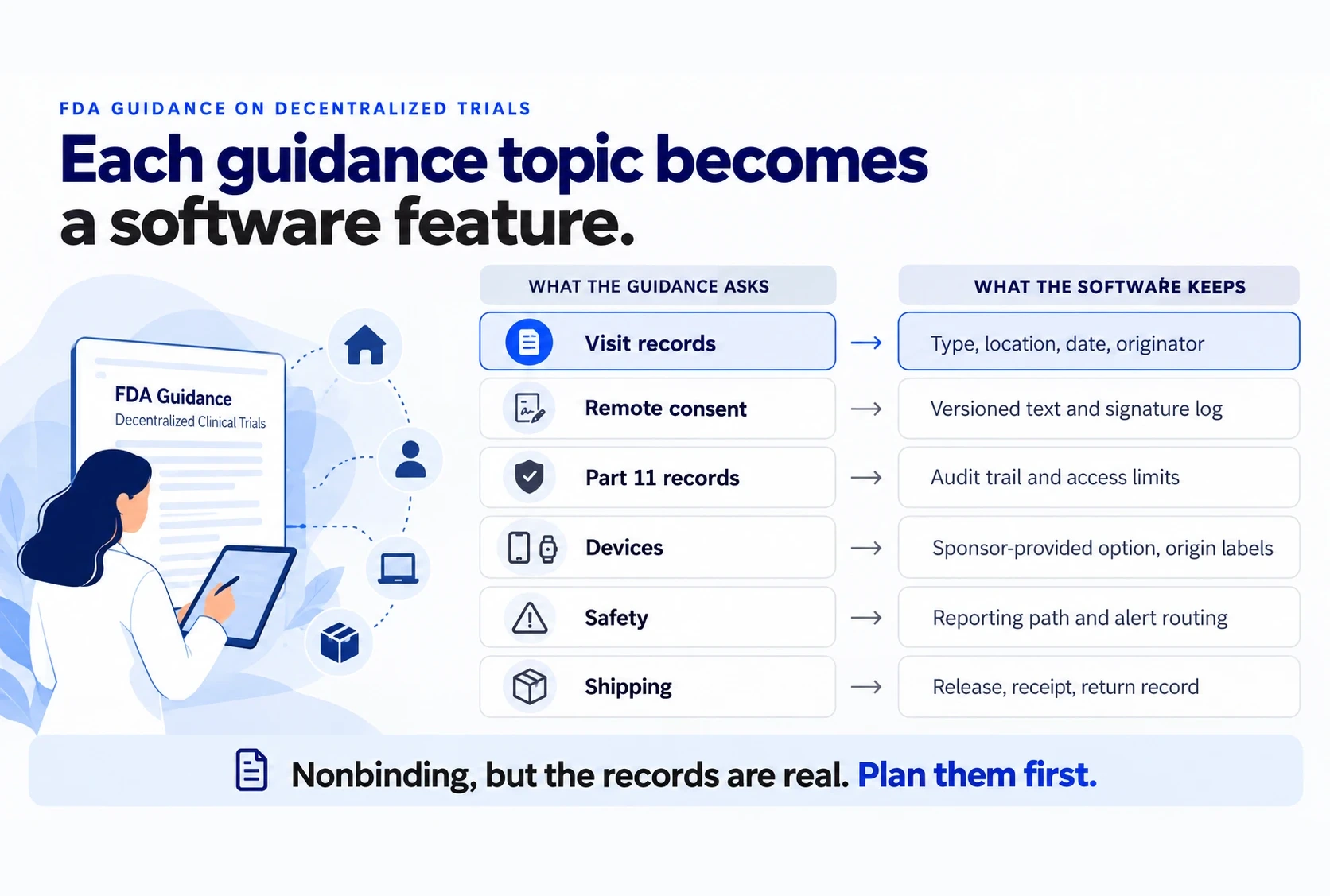
The FDA guidance on decentralized trials becomes useful to a build team when each topic turns into a testable requirement. The table below maps the topics covered in this guide to a software feature and a way to test it. It is a starting point for your own requirements, not a compliance claim.
|
Guidance topic |
Software feature |
How to test it |
|
Visit records |
Four fields per visit: type, location, date, originator |
Create a visit of each type and check all four fields |
|
Data flow |
Data map and list of service providers |
Trace one value from entry to the study database |
|
Remote consent |
Versioned consent with signature log and contacts |
Change the text and confirm re-consent is requested |
|
Part 11 records |
Audit trail, access limits, signatures |
Edit a value and check the log shows who, what and when |
|
Devices |
Sponsor-provided option and origin labels |
Run a task on a basic phone and on a wearable |
|
Safety |
Reporting path, alert routing, visit booking |
Trigger an alert and follow it to a staff action |
|
Shipping |
Shipment record with release, receipt and return |
Ship a test kit and close the record |
Use the table in three steps. Keep it simple. First, list the guidance topics that apply to your trial. Second, write one requirement for each, with a pass or fail test. Third, ask your quality team to review the list before design starts.
Keep the list alive. The FDA decentralized clinical trials guidance may change, and so may the DCT regulations around it. The FDA says it updates its guidance documents from time to time. The DCT guidance also points to other documents that were still in draft when it came out. Check the current versions before each major build or audit.
Turn the FDA guidance on decentralized trials into one testable requirement per topic. Review the list with your quality team and recheck the current guidance before each build.
Conclusion
The FDA guidance on decentralized trials does not change the rules for trials. It explains how the existing rules apply when work moves to homes and local clinics. For software teams, that means complete visit records and versioned remote consent. It also means Part 11 controls, device access, safety paths and shipping records.
If you plan a remote or hybrid trial, see how our decentralized clinical trial software work turns these topics into features. Book a free scoping call with your protocol in hand, and we will map the guidance to a build plan.
FAQs
1. What is the FDA guidance on decentralized trials?
It is the FDA's final guidance "Conducting Clinical Trials With Decentralized Elements," announced on September 18, 2024. It covers remote visits, consent, devices, safety, shipping and systems.
2. Is the decentralized clinical trials FDA guidance mandatory?
No. The FDA decentralized clinical trials guidance is nonbinding and describes the FDA's current thinking. It also says FDA's requirements are the same with or without decentralized elements. Those requirements are binding.
3. Does 21 CFR Part 11 apply to a video visit?
The decentralized clinical trials FDA guidance says live video and audio exchanges are not electronic records. Part 11 does not apply to the call. The visit must still be documented. Electronic visit notes must be held in a system that meets Part 11.
4. Can a local doctor or nurse obtain informed consent in a DCT?
The FDA guidance on decentralized trials says the FDA does not consider consent an appropriate task for a local health care provider. The investigator is responsible for consent, and anyone the investigator delegates must know the protocol well and be properly trained.
5. What records should DCT software keep for each visit?
The guidance says study records should capture the visit type, the location, the date and the data originator. Telehealth visits should also show the name of the person who ran them.
6. Does software make a trial compliant with the FDA guidance?
No. Software provides controls and records. Whether the trial meets the guidance depends on how the sponsor runs it. Ask your quality team and legal advisers to confirm each requirement.
Related Insights
- Clinical Trial Software Development: Process, Features, Compliance and Cost — Clinical trial software development explained: build vs buy, Part 11, EMA and ICH E6(R3) rules, process and cost, from a $15K prototype.
- HIPAA Compliant App Development: Technical Requirements and Developer Checklist (2026) — Build HIPAA-compliant healthcare apps in 2026 with updated technical requirements, security measures, and a practical developer checklist...
- What is Software as a Medical Device (SaMD) : Definition, Classification, and Regulatory Pathways — Software as a Medical Device (SaMD) is software that performs a medical function without hardware. Learn how SaMD is classified, regulated...
- What Is IEC 62304 Compliance and Why It Matters for Medical Software — Learn what IEC 62304 requires, how to classify software safety, and build compliant medical software aligned with ISO 13485 and ISO 14971...
- How IoT Is Transforming Healthcare Through Remote Patient Monitoring — IoT in healthcare enables secure, at-home monitoring with FDA-regulated, connected devices. Learn how compliant, interoperable systems...