
Product Development

Chinmay Chandgude
What Is a Managed Development Team? (And Why It's Not Staff Augmentation)

Both models exist to solve the same surface problem: you need more engineering capacity than your current team can provide. Both involve external developers doing real work on your product. And both get described using terms like "dedicated team," "outsourced developers," and "extended team" so interchangeably that by the time most teams have signed a contract, they are not fully sure which model they actually chose.
The confusion costs them months. A team that needed managed delivery but hired augmented staff spends the first quarter building a management layer that was never budgeted. A team that needed specific skill integration but hired a managed team loses the direct control they needed over a core product decision.
This article defines both models precisely, maps the single most important difference between them, and gives you a practical test for choosing the right one before you commit.
For context on how these engagement decisions play out specifically in healthcare product development, our guide on healthcare software development trends in 2026 covers the broader build landscape.
What Is a Managed Development Team?
A managed development team is a self-contained, cross-functional engineering unit that takes full ownership of building and delivering a defined product or feature area, with the vendor managing execution and the client directing outcomes.
The word "managed" in the name refers to who manages the work, not to the presence of a management layer on top of individual contributors. In a managed team, the vendor owns the daily execution: sprint planning, code reviews, QA, deployment pipelines, team coordination, and delivery cadence. The client owns the product direction: what to build, why it matters, which trade-offs to make.
Standard composition of a managed development team
A managed team is cross-functional by design. Every function needed to ship a working product lives inside the team:
Frontend and backend developers matched to the required technology stack
QA engineer embedded in the team, not a downstream handoff
DevOps or platform engineer owning deployment pipelines and infrastructure
Delivery lead or PM who runs sprint rituals, removes blockers, and owns coordination with the client
Tech lead who owns architecture decisions and code quality standards
The client does not hire these roles separately. They come as a unit, configured for the product area being built.
What "managed" means in practice
In a managed team engagement, the vendor is accountable for the output of the team, not just its availability. If the delivery lead is sick, the vendor fills the gap. If a developer is underperforming, the vendor manages that. If a sprint is off track, the delivery lead surfaces it and resolves it. The client is not managing individuals, they are managing a result.
This is the distinction that matters. The IT staff augmentation market was valued at $299.3 billion in 2023 and is projected to reach $857.2 billion by 2031, growing at 13.2% CAGR according to Verified Market Research. Both models are growing. They are growing because they solve different problems, and the teams that pick the right one are the ones that understood the difference before they signed.
What Is Staff Augmentation, and What Problem Does It Actually Solve?
Staff augmentation is a hiring model where individual developers join your existing team temporarily, integrate into your tools and processes, and work under your direct management, the vendor's job ends at placement.
In staff augmentation, you are buying developers, not delivery. The vendor sources candidates, vets them, handles employment contracts, and provides a replacement if someone leaves. Everything after placement, task assignment, code reviews, sprint planning, architecture decisions, quality standards, is your team's responsibility.
What the vendor does and does not do
The vendor does | The vendor does not do |
Source and vet candidates | Run sprints or standups |
Handle employment admin and HR | Review code or enforce quality standards |
Provide a replacement if someone leaves | Own architecture decisions |
Manage their own billing and compliance | Take accountability for delivery outcomes |
The augmented developer works inside your team structure. They use your tools, follow your processes, and report to your leads. They are, in practice, temporary team members with a different employment arrangement.
When staff augmentation genuinely works
Staff augmentation is the right model in specific circumstances:
You have a strong internal technical lead with bandwidth to onboard and direct new developers daily
You have a bounded skill gap, you need a specific technology capability for 3–6 months
You are adding capacity to an existing build, not starting something new
You need the developer inside your culture and workflow, not operating as a separate unit
The model works well when those conditions are true. The mistake most teams make is choosing augmentation when those conditions are not true, and then discovering the gap only after spending months building the management infrastructure that was missing.
The hidden cost that does not appear on invoices
Staff augmentation appears cheaper on paper: $50–100 per hour per developer versus the blended rate of a managed team. The gap closes quickly in practice. According to industry analysis from Stratagem Systems, managing augmented staff requires 15–25% of a senior manager's time per developer for daily standups, task assignment, code reviews, and performance management. For four augmented developers, expect 25–40 hours of management time per week, time that has a real cost even if it does not appear on the vendor invoice. The break-even point between augmentation and a managed team is typically 9–12 months.
The Core Difference: Who Owns Delivery
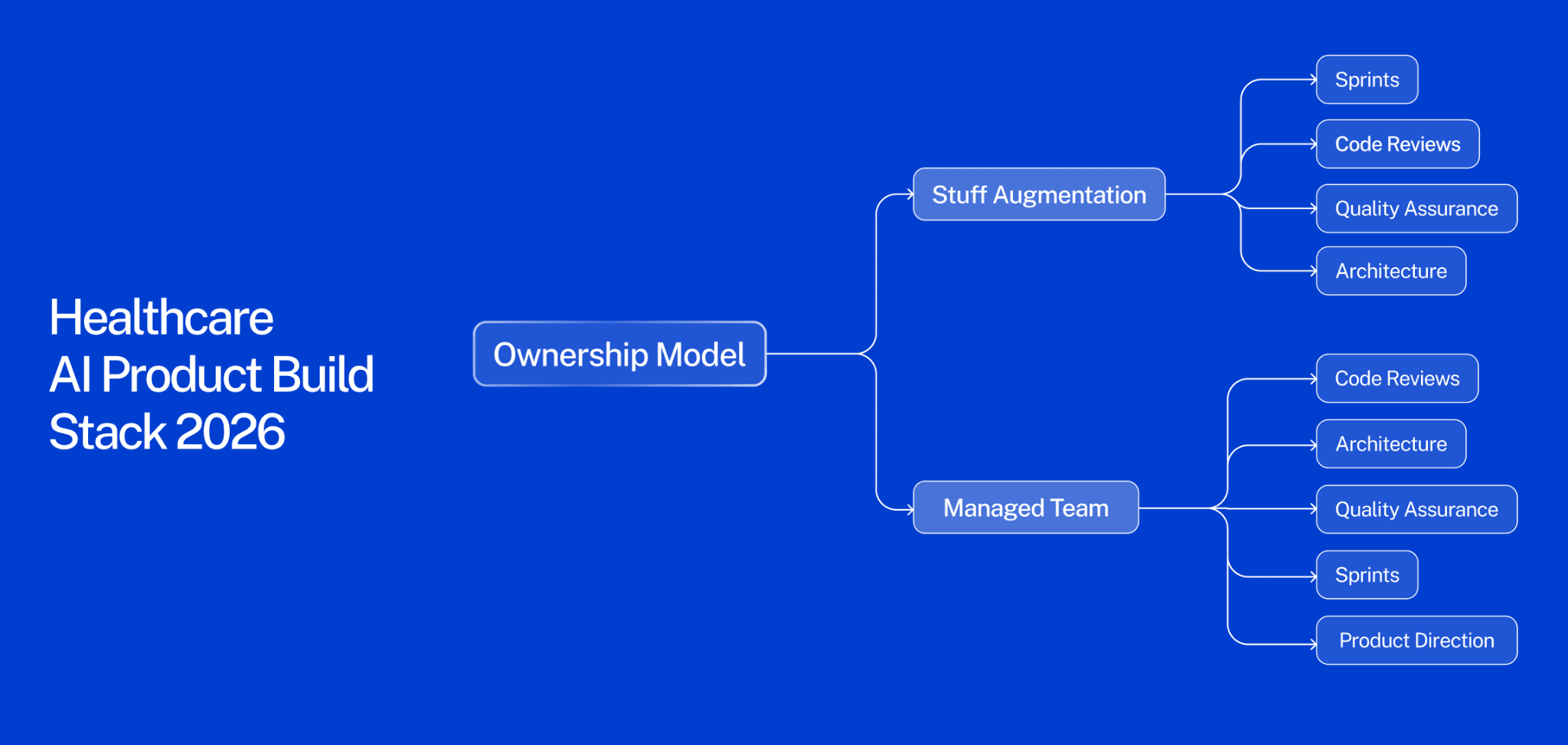
The fundamental difference between a managed development team and staff augmentation is who owns delivery: in augmentation you own every execution decision; in a managed team the vendor owns execution and you own product direction.
Everything else, the team composition, the billing model, the sprint structure, follows from this single distinction.
Side-by-side comparison
Staff augmentation | Managed development team | |
Who manages daily execution | You | The vendor's delivery lead |
Who owns code quality | You | The pod (embedded standards) |
Who handles team problems | You | The vendor |
Billing model | Per hour or per head | Against deliverables or fixed monthly |
What happens if a developer leaves | Your problem to manage | Vendor replaces and manages transition |
Knowledge retention | Leaves when developers leave | Documented in team processes |
Best engagement length | 3–6 months | 6+ months |
Internal management required | High (15–25% per developer) | Low (5–10% for direction and reviews) |
The billing distinction matters practically. Staff augmentation bills for time and presence. A managed team is contracted against output, deployment frequency, sprint completion, feature delivery. This aligns incentives differently: a managed team has reason to deliver, not just to show up.
The knowledge problem
Here is where the models diverge in ways that compound over time. In a staff augmentation arrangement, knowledge lives in the individuals. When a developer leaves, and in a 3–6 month engagement, many do, the context they built up over weeks of working in your codebase leaves with them. Each new addition restarts the learning curve.
In a managed team, knowledge lives in the team's documented processes. Architecture decisions are recorded. Sprint history is owned by the pod. The delivery lead carries institutional context. When an individual developer changes, the team continues without a knowledge cliff.
According to ManpowerGroup's 2025 Talent Shortage Survey, 76% of employers globally report difficulty filling skilled roles. In an environment where developer retention is a real challenge, the model you choose determines whether a departure costs you a sprint or a quarter.
When a Managed Development Team Is the Right Choice
A managed development team is the right choice when you need to ship a defined product or feature area and either lack the internal management capacity to direct individual developers or need delivery accountability built into the engagement from day one.
Choosing a managed team is not about whether you trust the vendor. It is about matching the model to your internal capacity and the nature of the work.
Five situations where managed teams outperform augmentation
You do not have an internal technical lead with daily management bandwidth. Staff augmentation requires constant direction. If your CTO or senior engineer is also responsible for product architecture, investor updates, or three other initiatives, they do not have the bandwidth to manage augmented developers effectively. The managed team model takes that execution load off them.
You are building something new from scratch. Augmentation fills gaps in an existing build. A managed team builds the thing. Starting a new product or a new feature area with augmented staff means the architecture, the standards, the sprint structure, and the team culture all have to come from you. That works if you have the capacity to define all of it. Most early-stage teams do not.
The engagement is longer than six months. Analysis from aTeam Soft Solutions finds that choosing the wrong engagement model results in 30–50% overhead cost increases and 3–6 month delays. For long-term builds, management overhead from augmentation compounds. A managed team's overhead does not scale with time the same way.
You need compliance decisions documented throughout the build. This is particularly relevant for healthcare products. HIPAA compliance decisions, architecture documentation, and sprint governance require the ownership model of a managed team. Individual augmented developers do not produce compliance decision logs or architecture records as part of their default operating mode. A managed pod does.
You have tried augmentation and found coordination overhead ate the velocity gain. The most reliable signal that a team needed a managed model is discovering it after choosing augmentation. If previous augmentation experience produced coordination overhead but not delivery velocity, a managed team addresses the root cause.
For teams building healthcare products specifically, our guide to outsourcing healthcare product development without losing control covers the governance decisions that come with both models in a regulated environment.
Not sure which model fits your product stage? Book a free 30-minute call with the Latent team. We have shipped 100+ products using managed pod engagements and can tell you in one conversation which model matches your situation. Book a free call →
When Staff Augmentation Is the Right Choice
Staff augmentation is the right choice when you have a specific, bounded skill gap, a strong internal technical lead with bandwidth to direct new team members, and a short-term engagement where integration into your existing team matters more than standalone delivery.
Augmentation is not the wrong model. It is the wrong model for the wrong situation. In the right situation, it is faster, more flexible, and gives you direct control over every execution decision.
Four situations where augmentation is genuinely better
You need a specific technology skill for a bounded time. If you need a blockchain engineer for one integration, a machine learning specialist for a three-month proof of concept, or a DevOps engineer to set up infrastructure, augmentation delivers in days, not weeks. You do not need a full managed team for a specific, defined role.
You have a strong internal PM or technical lead with genuine availability. If you have a senior engineer who can run daily standups, assign work, and review code, and who actually has the time to do this, augmentation works as intended. The model assumes that person exists. If they do, it is efficient.
You are extending an existing build, not starting a new one. Adding a developer to an existing team that has established architecture, processes, and culture is a different problem from building a new product. Augmentation handles the former well. The developer plugs in. A managed team is overengineered for this.
You want maximum flexibility for a short engagement. Staff augmentation has lower commitment overhead for engagements under 6 months. No team setup, no onboarding of a full pod structure. You start building faster for a short sprint.
The honest trade-off: augmentation gives you more control day-to-day. It also gives you more responsibility day-to-day. That trade-off only works if the internal capacity to carry that responsibility genuinely exists.
What a Managed Development Team Looks Like in Practice
In practice, a managed development team operates with a fortnightly sprint demo where the client directs product decisions, a delivery lead who owns daily coordination, and documented processes that ensure the build is continuable by any team, not just the original one.
McKinsey analysis of agile, cross-functional team structures found they can boost productivity by up to 30% and cut time-to-market by 40% compared to traditional functional team structures. The mechanism is straightforward: when every discipline needed to ship sits in the same team, the handoffs that create delays disappear.
What a sprint looks like inside a managed pod
What the pod owns:
Sprint planning and backlog prioritization in the agreed tooling
Daily standups and team coordination
Code reviews against documented standards
QA embedded in the sprint, not after it
Deployment to staging and production
A compliance decision log for every sprint (for regulated products)
What the client does:
Attends the fortnightly sprint demo and makes product decisions
Reviews the compliance log and flags open questions
Provides domain knowledge and stakeholder input
Sets product direction for the next sprint
The client is not absent, they are directing outcomes rather than managing individuals. The fortnightly demo is where product decisions happen. Between demos, the pod runs.
The three things that make a managed team different from an outsourced project
Outcome accountability. The team is measured on what ships and how it performs, not on hours logged. Delivery lead time, deployment frequency, and defect rates are tracked and visible to the client.
Knowledge retention by design. Architecture decisions are documented as they are made. Sprint history is owned by the pod. When team composition changes, the build continues without a knowledge cliff.
Compliance built into the operating rhythm. For healthcare products, where HIPAA decisions, PHI handling, and architecture documentation are legal requirements, a managed pod generates these records as a default output of every sprint. They are not retrofitted at the end of the engagement.
For teams evaluating how AI development decisions interact with sprint governance, our guide to AI in healthcare product development 2026 covers the architecture and compliance decisions that arise at the intersection of both.
Latent's managed pods deliver MVPs in 8–14 weeks with IP ownership, sprint visibility, and compliance documentation built in from day one. If you want to see what this looks like for a product in your space, book a free discovery sprint.
The Decision Test: Which Model Is Right for You?
The single most reliable test for choosing between a managed development team and staff augmentation is this: do you want to manage execution yourself, or do you want to buy managed execution?
Both answers are legitimate. The mistake is answering one and hiring the other.
Five-question decision test
Answer each question, then read the result below.
Question | If yes, points to... | If no, points to... |
Do you have an internal technical lead with genuine daily bandwidth to manage developers? | Staff augmentation | Managed team |
Are you filling a gap in an existing build (not starting something new)? | Staff augmentation | Managed team |
Is the engagement shorter than 6 months? | Staff augmentation | Managed team |
Does the build require documented compliance decisions throughout (e.g., HIPAA, FDA)? | Managed team | Either model works |
Have previous augmentation engagements created coordination overhead without proportional velocity? | Managed team | Staff augmentation |
Reading the result: If your answers mostly point to staff augmentation, you have a strong technical lead, you are filling a short-term gap, you want direct control over a bounded skill area, augmentation is the efficient choice. If your answers mostly point to managed team, you need to build something new, you do not have bandwidth to manage developers daily, the engagement runs long, or you need compliance built in, a managed team is the right structural fit.
The most common mistake is answering "managed team" for every question and choosing augmentation because the hourly rate looks lower. The total cost of ownership at 12 months is rarely in augmentation's favour once management overhead is counted.
Frequently Asked Questions
What is a managed development team?
A managed development team is a cross-functional engineering unit, typically including developers, QA, DevOps, and a delivery lead, that takes full ownership of building and delivering a defined product or feature area. The vendor manages daily execution including sprint planning, code reviews, and deployment. The client owns product direction. This is different from staff augmentation, where individual developers join the client's team and work under the client's direct management.
What is the difference between a managed development team and staff augmentation?
The core difference is who owns delivery. In staff augmentation, the client owns every execution decision: task assignment, code review, sprint planning, and quality standards. The vendor's role ends at placement. In a managed development team, the vendor owns execution and the client owns product direction. This difference determines management overhead, knowledge retention, compliance documentation, and long-term total cost of ownership.
When should you use a managed development team?
A managed development team is the right choice when: you do not have an internal technical lead with daily bandwidth to manage developers; you are building a new product or feature area from scratch; the engagement will run longer than six months; you need compliance decisions documented throughout the build (especially for healthcare or regulated products); or previous augmentation engagements produced coordination overhead without proportional delivery velocity.
How much does a managed development team cost?
Managed development teams typically bill at a blended monthly rate covering developers, QA, DevOps, and a delivery lead, usually $15,000–$40,000 per month depending on team size, geography, and domain complexity. This appears higher than staff augmentation's hourly rate. However, staff augmentation requires 15–25% of a senior manager's time per developer, plus onboarding overhead, plus knowledge replacement costs when developers leave. For engagements longer than 9–12 months, a managed team typically has lower total cost of ownership.
What roles are included in a managed development team?
A standard managed development team includes frontend and backend developers matched to the required technology stack, an embedded QA engineer, a DevOps or platform engineer, a delivery lead who runs sprint rituals and client communication, and a tech lead who owns architecture and code quality. For healthcare products, the team also produces a per-sprint compliance decision log and architecture documentation as default deliverables. The exact composition scales with product scope.
Both models exist to solve the same surface problem: you need more engineering capacity than your current team can provide. Both involve external developers doing real work on your product. And both get described using terms like "dedicated team," "outsourced developers," and "extended team" so interchangeably that by the time most teams have signed a contract, they are not fully sure which model they actually chose.
The confusion costs them months. A team that needed managed delivery but hired augmented staff spends the first quarter building a management layer that was never budgeted. A team that needed specific skill integration but hired a managed team loses the direct control they needed over a core product decision.
This article defines both models precisely, maps the single most important difference between them, and gives you a practical test for choosing the right one before you commit.
For context on how these engagement decisions play out specifically in healthcare product development, our guide on healthcare software development trends in 2026 covers the broader build landscape.
What Is a Managed Development Team?
A managed development team is a self-contained, cross-functional engineering unit that takes full ownership of building and delivering a defined product or feature area, with the vendor managing execution and the client directing outcomes.
The word "managed" in the name refers to who manages the work, not to the presence of a management layer on top of individual contributors. In a managed team, the vendor owns the daily execution: sprint planning, code reviews, QA, deployment pipelines, team coordination, and delivery cadence. The client owns the product direction: what to build, why it matters, which trade-offs to make.
Standard composition of a managed development team
A managed team is cross-functional by design. Every function needed to ship a working product lives inside the team:
Frontend and backend developers matched to the required technology stack
QA engineer embedded in the team, not a downstream handoff
DevOps or platform engineer owning deployment pipelines and infrastructure
Delivery lead or PM who runs sprint rituals, removes blockers, and owns coordination with the client
Tech lead who owns architecture decisions and code quality standards
The client does not hire these roles separately. They come as a unit, configured for the product area being built.
What "managed" means in practice
In a managed team engagement, the vendor is accountable for the output of the team, not just its availability. If the delivery lead is sick, the vendor fills the gap. If a developer is underperforming, the vendor manages that. If a sprint is off track, the delivery lead surfaces it and resolves it. The client is not managing individuals, they are managing a result.
This is the distinction that matters. The IT staff augmentation market was valued at $299.3 billion in 2023 and is projected to reach $857.2 billion by 2031, growing at 13.2% CAGR according to Verified Market Research. Both models are growing. They are growing because they solve different problems, and the teams that pick the right one are the ones that understood the difference before they signed.
What Is Staff Augmentation, and What Problem Does It Actually Solve?
Staff augmentation is a hiring model where individual developers join your existing team temporarily, integrate into your tools and processes, and work under your direct management, the vendor's job ends at placement.
In staff augmentation, you are buying developers, not delivery. The vendor sources candidates, vets them, handles employment contracts, and provides a replacement if someone leaves. Everything after placement, task assignment, code reviews, sprint planning, architecture decisions, quality standards, is your team's responsibility.
What the vendor does and does not do
The vendor does | The vendor does not do |
Source and vet candidates | Run sprints or standups |
Handle employment admin and HR | Review code or enforce quality standards |
Provide a replacement if someone leaves | Own architecture decisions |
Manage their own billing and compliance | Take accountability for delivery outcomes |
The augmented developer works inside your team structure. They use your tools, follow your processes, and report to your leads. They are, in practice, temporary team members with a different employment arrangement.
When staff augmentation genuinely works
Staff augmentation is the right model in specific circumstances:
You have a strong internal technical lead with bandwidth to onboard and direct new developers daily
You have a bounded skill gap, you need a specific technology capability for 3–6 months
You are adding capacity to an existing build, not starting something new
You need the developer inside your culture and workflow, not operating as a separate unit
The model works well when those conditions are true. The mistake most teams make is choosing augmentation when those conditions are not true, and then discovering the gap only after spending months building the management infrastructure that was missing.
The hidden cost that does not appear on invoices
Staff augmentation appears cheaper on paper: $50–100 per hour per developer versus the blended rate of a managed team. The gap closes quickly in practice. According to industry analysis from Stratagem Systems, managing augmented staff requires 15–25% of a senior manager's time per developer for daily standups, task assignment, code reviews, and performance management. For four augmented developers, expect 25–40 hours of management time per week, time that has a real cost even if it does not appear on the vendor invoice. The break-even point between augmentation and a managed team is typically 9–12 months.
The Core Difference: Who Owns Delivery

The fundamental difference between a managed development team and staff augmentation is who owns delivery: in augmentation you own every execution decision; in a managed team the vendor owns execution and you own product direction.
Everything else, the team composition, the billing model, the sprint structure, follows from this single distinction.
Side-by-side comparison
Staff augmentation | Managed development team | |
Who manages daily execution | You | The vendor's delivery lead |
Who owns code quality | You | The pod (embedded standards) |
Who handles team problems | You | The vendor |
Billing model | Per hour or per head | Against deliverables or fixed monthly |
What happens if a developer leaves | Your problem to manage | Vendor replaces and manages transition |
Knowledge retention | Leaves when developers leave | Documented in team processes |
Best engagement length | 3–6 months | 6+ months |
Internal management required | High (15–25% per developer) | Low (5–10% for direction and reviews) |
The billing distinction matters practically. Staff augmentation bills for time and presence. A managed team is contracted against output, deployment frequency, sprint completion, feature delivery. This aligns incentives differently: a managed team has reason to deliver, not just to show up.
The knowledge problem
Here is where the models diverge in ways that compound over time. In a staff augmentation arrangement, knowledge lives in the individuals. When a developer leaves, and in a 3–6 month engagement, many do, the context they built up over weeks of working in your codebase leaves with them. Each new addition restarts the learning curve.
In a managed team, knowledge lives in the team's documented processes. Architecture decisions are recorded. Sprint history is owned by the pod. The delivery lead carries institutional context. When an individual developer changes, the team continues without a knowledge cliff.
According to ManpowerGroup's 2025 Talent Shortage Survey, 76% of employers globally report difficulty filling skilled roles. In an environment where developer retention is a real challenge, the model you choose determines whether a departure costs you a sprint or a quarter.
When a Managed Development Team Is the Right Choice
A managed development team is the right choice when you need to ship a defined product or feature area and either lack the internal management capacity to direct individual developers or need delivery accountability built into the engagement from day one.
Choosing a managed team is not about whether you trust the vendor. It is about matching the model to your internal capacity and the nature of the work.
Five situations where managed teams outperform augmentation
You do not have an internal technical lead with daily management bandwidth. Staff augmentation requires constant direction. If your CTO or senior engineer is also responsible for product architecture, investor updates, or three other initiatives, they do not have the bandwidth to manage augmented developers effectively. The managed team model takes that execution load off them.
You are building something new from scratch. Augmentation fills gaps in an existing build. A managed team builds the thing. Starting a new product or a new feature area with augmented staff means the architecture, the standards, the sprint structure, and the team culture all have to come from you. That works if you have the capacity to define all of it. Most early-stage teams do not.
The engagement is longer than six months. Analysis from aTeam Soft Solutions finds that choosing the wrong engagement model results in 30–50% overhead cost increases and 3–6 month delays. For long-term builds, management overhead from augmentation compounds. A managed team's overhead does not scale with time the same way.
You need compliance decisions documented throughout the build. This is particularly relevant for healthcare products. HIPAA compliance decisions, architecture documentation, and sprint governance require the ownership model of a managed team. Individual augmented developers do not produce compliance decision logs or architecture records as part of their default operating mode. A managed pod does.
You have tried augmentation and found coordination overhead ate the velocity gain. The most reliable signal that a team needed a managed model is discovering it after choosing augmentation. If previous augmentation experience produced coordination overhead but not delivery velocity, a managed team addresses the root cause.
For teams building healthcare products specifically, our guide to outsourcing healthcare product development without losing control covers the governance decisions that come with both models in a regulated environment.
Not sure which model fits your product stage? Book a free 30-minute call with the Latent team. We have shipped 100+ products using managed pod engagements and can tell you in one conversation which model matches your situation. Book a free call →
When Staff Augmentation Is the Right Choice
Staff augmentation is the right choice when you have a specific, bounded skill gap, a strong internal technical lead with bandwidth to direct new team members, and a short-term engagement where integration into your existing team matters more than standalone delivery.
Augmentation is not the wrong model. It is the wrong model for the wrong situation. In the right situation, it is faster, more flexible, and gives you direct control over every execution decision.
Four situations where augmentation is genuinely better
You need a specific technology skill for a bounded time. If you need a blockchain engineer for one integration, a machine learning specialist for a three-month proof of concept, or a DevOps engineer to set up infrastructure, augmentation delivers in days, not weeks. You do not need a full managed team for a specific, defined role.
You have a strong internal PM or technical lead with genuine availability. If you have a senior engineer who can run daily standups, assign work, and review code, and who actually has the time to do this, augmentation works as intended. The model assumes that person exists. If they do, it is efficient.
You are extending an existing build, not starting a new one. Adding a developer to an existing team that has established architecture, processes, and culture is a different problem from building a new product. Augmentation handles the former well. The developer plugs in. A managed team is overengineered for this.
You want maximum flexibility for a short engagement. Staff augmentation has lower commitment overhead for engagements under 6 months. No team setup, no onboarding of a full pod structure. You start building faster for a short sprint.
The honest trade-off: augmentation gives you more control day-to-day. It also gives you more responsibility day-to-day. That trade-off only works if the internal capacity to carry that responsibility genuinely exists.
What a Managed Development Team Looks Like in Practice
In practice, a managed development team operates with a fortnightly sprint demo where the client directs product decisions, a delivery lead who owns daily coordination, and documented processes that ensure the build is continuable by any team, not just the original one.
McKinsey analysis of agile, cross-functional team structures found they can boost productivity by up to 30% and cut time-to-market by 40% compared to traditional functional team structures. The mechanism is straightforward: when every discipline needed to ship sits in the same team, the handoffs that create delays disappear.
What a sprint looks like inside a managed pod
What the pod owns:
Sprint planning and backlog prioritization in the agreed tooling
Daily standups and team coordination
Code reviews against documented standards
QA embedded in the sprint, not after it
Deployment to staging and production
A compliance decision log for every sprint (for regulated products)
What the client does:
Attends the fortnightly sprint demo and makes product decisions
Reviews the compliance log and flags open questions
Provides domain knowledge and stakeholder input
Sets product direction for the next sprint
The client is not absent, they are directing outcomes rather than managing individuals. The fortnightly demo is where product decisions happen. Between demos, the pod runs.
The three things that make a managed team different from an outsourced project
Outcome accountability. The team is measured on what ships and how it performs, not on hours logged. Delivery lead time, deployment frequency, and defect rates are tracked and visible to the client.
Knowledge retention by design. Architecture decisions are documented as they are made. Sprint history is owned by the pod. When team composition changes, the build continues without a knowledge cliff.
Compliance built into the operating rhythm. For healthcare products, where HIPAA decisions, PHI handling, and architecture documentation are legal requirements, a managed pod generates these records as a default output of every sprint. They are not retrofitted at the end of the engagement.
For teams evaluating how AI development decisions interact with sprint governance, our guide to AI in healthcare product development 2026 covers the architecture and compliance decisions that arise at the intersection of both.
Latent's managed pods deliver MVPs in 8–14 weeks with IP ownership, sprint visibility, and compliance documentation built in from day one. If you want to see what this looks like for a product in your space, book a free discovery sprint.
The Decision Test: Which Model Is Right for You?
The single most reliable test for choosing between a managed development team and staff augmentation is this: do you want to manage execution yourself, or do you want to buy managed execution?
Both answers are legitimate. The mistake is answering one and hiring the other.
Five-question decision test
Answer each question, then read the result below.
Question | If yes, points to... | If no, points to... |
Do you have an internal technical lead with genuine daily bandwidth to manage developers? | Staff augmentation | Managed team |
Are you filling a gap in an existing build (not starting something new)? | Staff augmentation | Managed team |
Is the engagement shorter than 6 months? | Staff augmentation | Managed team |
Does the build require documented compliance decisions throughout (e.g., HIPAA, FDA)? | Managed team | Either model works |
Have previous augmentation engagements created coordination overhead without proportional velocity? | Managed team | Staff augmentation |
Reading the result: If your answers mostly point to staff augmentation, you have a strong technical lead, you are filling a short-term gap, you want direct control over a bounded skill area, augmentation is the efficient choice. If your answers mostly point to managed team, you need to build something new, you do not have bandwidth to manage developers daily, the engagement runs long, or you need compliance built in, a managed team is the right structural fit.
The most common mistake is answering "managed team" for every question and choosing augmentation because the hourly rate looks lower. The total cost of ownership at 12 months is rarely in augmentation's favour once management overhead is counted.
Frequently Asked Questions
What is a managed development team?
A managed development team is a cross-functional engineering unit, typically including developers, QA, DevOps, and a delivery lead, that takes full ownership of building and delivering a defined product or feature area. The vendor manages daily execution including sprint planning, code reviews, and deployment. The client owns product direction. This is different from staff augmentation, where individual developers join the client's team and work under the client's direct management.
What is the difference between a managed development team and staff augmentation?
The core difference is who owns delivery. In staff augmentation, the client owns every execution decision: task assignment, code review, sprint planning, and quality standards. The vendor's role ends at placement. In a managed development team, the vendor owns execution and the client owns product direction. This difference determines management overhead, knowledge retention, compliance documentation, and long-term total cost of ownership.
When should you use a managed development team?
A managed development team is the right choice when: you do not have an internal technical lead with daily bandwidth to manage developers; you are building a new product or feature area from scratch; the engagement will run longer than six months; you need compliance decisions documented throughout the build (especially for healthcare or regulated products); or previous augmentation engagements produced coordination overhead without proportional delivery velocity.
How much does a managed development team cost?
Managed development teams typically bill at a blended monthly rate covering developers, QA, DevOps, and a delivery lead, usually $15,000–$40,000 per month depending on team size, geography, and domain complexity. This appears higher than staff augmentation's hourly rate. However, staff augmentation requires 15–25% of a senior manager's time per developer, plus onboarding overhead, plus knowledge replacement costs when developers leave. For engagements longer than 9–12 months, a managed team typically has lower total cost of ownership.
What roles are included in a managed development team?
A standard managed development team includes frontend and backend developers matched to the required technology stack, an embedded QA engineer, a DevOps or platform engineer, a delivery lead who runs sprint rituals and client communication, and a tech lead who owns architecture and code quality. For healthcare products, the team also produces a per-sprint compliance decision log and architecture documentation as default deliverables. The exact composition scales with product scope.

Chinmay Chandgude is a partner at Latent with over 9 years of experience in building custom digital platforms for healthcare and finance sectors. He focuses on creating scalable and secure web and mobile applications to drive technological transformation. Based in Pune, India, Chinmay is passionate about delivering user-centric solutions that improve efficiency and reduce costs.
Related Posts
Free MVP Architecture
Share your product idea — we'll design your MVP architecture for free, no commitment required. If it's a good fit, we'll show you what building it looks like.