
Decentralized clinical trial software lets a study reach people at home instead of asking them to travel to a clinic. It joins consent, questionnaires, devices, visits and data in one system. This guide shows what decentralized clinical trial software must include, when to build or buy it, which rules apply and what it costs.
Key Takeaways
- Decentralized clinical trial software is a set of connected parts, not one app. It covers consent, outcome forms, remote visits, wearable data and a staff portal. A weak link in any part breaks the trial.
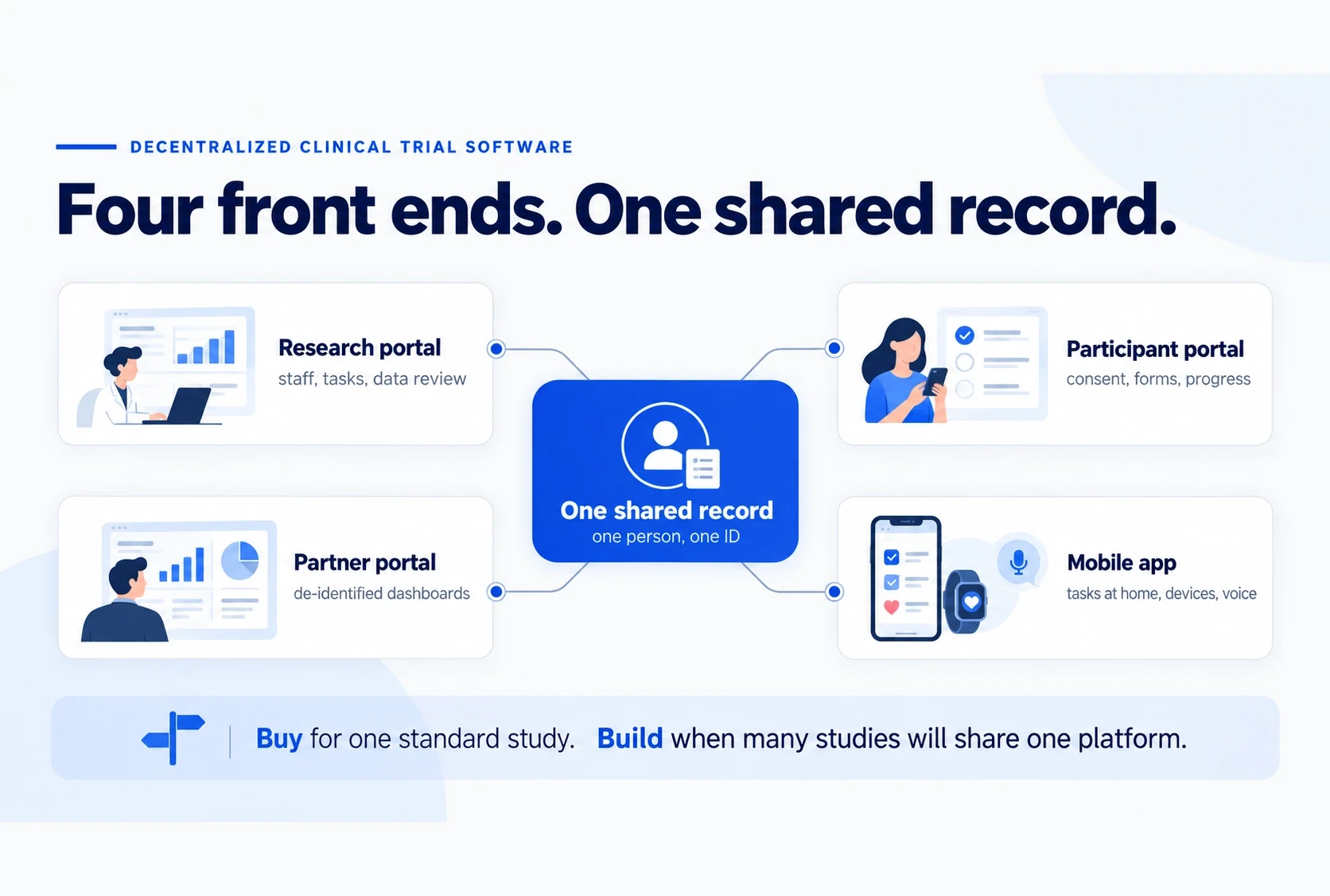
- A decentralized clinical trial platform usually needs four front ends: a research portal for staff, a participant portal, a partner portal and a mobile app. All four should share one record of each person.
- Buy when your trial is standard and short. Build when your protocol, instruments or partners do not fit a vendor tool, or when you plan many studies. Decentralized clinical trial software you own can serve every later study.
- Latent HQ lists DCT builds with MVPs in 8 to 12 weeks and no fixed price. Its clinical research page shows a prototype from $15,000 and custom EDC or CTMS builds at $70K to $175K as reference points.
What Is Decentralized Clinical Trial Software?
Decentralized clinical trial software is the set of tools that lets trial activity happen away from a research site. The U.S. Food and Drug Administration (FDA) says, in its notice of the final guidance, that decentralized elements let trial-related activities happen remotely at locations convenient for participants. That can mean the person's home, a local clinic or a mobile unit.
Decentralized clinical trial software is what makes those places work as part of one study. A nurse at a local clinic, a person at home and a coordinator at the main site all need to see the right data and the right forms. Without that link, the trial just has more places to lose information.
A decentralized trial is not all or nothing. The Clinical Trials Transformation Initiative says these trials sit on a wide spectrum. They can be fully virtual, hybrid or close to a traditional trial. Your software must match where your study sits on that range.
A healthcare software development company is often asked for a single "DCT app". The first step is to explain that decentralized clinical trial software is a platform. It has many parts, and each part serves a different person: the participant, the coordinator, the investigator and the sponsor.
The FDA also lists what these trials may offer. It says remote participation may ease the burden on caregivers and help research on rare diseases. It also notes that telehealth means fewer in-person visits. Good software has to make that real in daily use. Decentralized clinical trial software succeeds when a person with limited mobility can finish every task without help.
Decentralized clinical trial software connects consent, outcome forms, remote visits, devices and data so a study can run outside a clinic.
Which Components Does a DCT Platform Need?
A decentralized clinical trial platform needs eight core parts. Not every trial uses all eight. Most use five or six. The table lists each part and what it does for the study.
|
Component |
What it does |
Who uses it |
|
Remote enrollment and eConsent |
Screens people and records versioned consent |
Participants, coordinators |
|
eCOA and ePRO |
Captures questionnaires, diaries and scored instruments |
Participants |
|
Telehealth visits |
Runs video or phone visits with a visit record |
Participants, investigators |
|
Device and wearable feeds |
Brings in sensor data between visits |
Participants, analysts |
|
EDC link |
Moves values into the study database |
Data managers |
|
Supply and home-visit tracking |
Tracks shipments and local nurse visits |
Coordinators |
|
Staff portal |
Shows tasks, alerts and visit status |
Study staff |
|
Reporting layer |
Shows progress without personal details |
Sponsors, partners |
Two of these parts deserve extra attention. The first is consent. In a remote trial, the consent form is the only thing a person sees before agreeing. It must be clear, saved by version and tied to a time stamp. If the form changes, the software must ask people to agree again.
The second is outcome capture. Latent HQ builds eCOA and ePRO software for validated instruments, voice tasks and wearable endpoints. These parts feed the main endpoints of many studies, so a weak outcome form can damage the whole data set.
Many decentralized clinical trial software projects fail at the join between parts. A consent form lives in one tool, the questionnaire in a second and the device data in a third. Each tool has its own login. People give up, and the study loses them. Start by asking whether each part can share one person record and one login.
The same point holds for staff. A coordinator who opens four screens to see one person will miss a late form. A staff portal that shows all open tasks in one list lowers that risk.
Remote enrollment sets the tone for the whole trial. A person finds the study, answers a short screening form and reads the consent in plain words. The software should check eligibility as the answers come in and route unclear cases to a coordinator. It should also let a person save and return later. Many people read consent in two or three sittings, and a form that loses their place costs the study a participant.
Telehealth visits need the same care. A video visit should open from one link, work on a basic phone and write a visit note to the study record. If the call drops, the software should let staff finish by phone and record that change. Small details like these decide whether people stay in a remote trial.
A decentralized clinical trial platform is a set of connected parts, and the weakest join between them decides how many people finish the study.
How Do the Four Portals Fit Together?
Decentralized clinical trial software often ends up as four connected front ends on one back end. The clearest example in our own work is the platform behind an ALS research network. Latent HQ built the ALS research platform as a research portal, a participant portal, a consortia portal and a mobile app.
Each one serves a different group.
- Research portal. Staff enroll people, assign studies, check task lists and review data. Roles limit what each staff member sees.
- Participant portal. People sign consent, complete assessments and see their own progress on the web.
- Consortia portal. Pharma and academic partners see de-identified, near real-time dashboards. They never see names.
- Mobile app. People complete tasks at home on a phone, including voice and device-based tasks.
All four sit on one record of each person. That is the key design choice. A person who signs up on the phone shows up in the staff portal with the same ID. A partner dashboard draws from the same data, with identity removed.
The Latent HQ case study states that this platform supports 900+ participants across 8 active studies in the US and Australia. Those numbers come from the case study and the service page, not from outside research. They show one point: one back end can serve many studies if it is designed for that from the start.
Role-based access matters here more than anywhere else. Staff, participants and partners must each see only what their role allows. The access rule belongs in the back end, not in the screen design. Otherwise a new screen can reveal data it should not.
A multi-study design also needs a clear study layer. Each study has its own forms, schedule and consent. The person layer sits beneath it. This lets one person join a second study without a second sign-up. It is also the part that is hardest to add later.
A four-portal design puts staff, participants, partners and a mobile app on one shared record, with access rules set in the back end.
How Does the Software Handle Trial Data?
Decentralized clinical trial software must move data between parts without retyping. This is where much of the build effort goes. Data in decentralized clinical trial software comes from forms, video visits, devices and local clinics. It has to land in one place in one format.
Most programs send outcome and visit data into an electronic data capture (EDC) system. Our primer on EDC in clinical trials describes how that database works. In a DCT, the EDC system still holds the study record. The DCT software feeds it.
Device data is a different problem. A wearable can send readings every minute. A study may need only a daily summary. The software must decide what to keep, how to label it and how to show it to staff. Wearable data is a common source of this problem.
Four rules keep this clean.
- Keep one source for each value. If a value is entered in two places, one of them will be wrong.
- Time-stamp every entry. The record must show who entered each value and when.
- Log every change. Edits need a reason and a trail, so the study can be reviewed later.
- Separate identity from analysis. Partner views should never carry names or contact details.
Data from local clinics adds a further step. A local nurse may take a blood sample or run a simple test. The software should let that nurse enter results with the same checks used at the main site. Otherwise the study has two data quality levels.
Finally, plan for missing data. A person at home may skip a diary entry or lose a device signal. The software should flag a gap quickly, send a reminder and let staff follow up. A silent gap is the most common way a remote trial loses data.
DCT software feeds a study database from many remote sources, so one source per value, full audit trails and identity-free partner views keep the data usable.
Build or Buy Decentralized Clinical Trial Software?
Build or buy decentralized clinical trial software depends on how much your trial differs from the standard case. A bought tool is faster for a simple, one-time study, but decentralized clinical trial software you build fits an unusual one. A custom build gives control when the protocol, instruments or partners are unusual, or when many studies will follow.
|
Question |
Buy a vendor tool |
Build custom DCT software |
|
Time to first study |
Short, if the protocol fits |
8 to 12 weeks for an MVP, per Latent HQ |
|
Fit to unusual instruments |
Limited to what the vendor supports |
Built to your protocol and scoring |
|
Cost shape |
Recurring fees per study or per person |
Upfront build, then lower running cost |
|
Ownership |
Vendor owns the code and sets the roadmap |
You own code, data and documentation |
|
Many studies |
Each study may add fees |
One back end can serve every study |
Use this short test. Buy if your trial has a standard design, a fixed end date and no plan for a second study. Build if you plan several studies, run a rare-disease program, need voice or device endpoints, or must share de-identified data with partners.
A hybrid path also works. Many teams buy a standard part, such as a video visit tool, and build the parts that make their study different. This keeps cost down. It also keeps the unique part under your control. Owning the video layer, as our guide to telemedicine platform development shows, is possible but rarely needed.
Ownership deserves a closer look. If a vendor owns the platform, your data model follows the vendor's design. Moving to another system later can be slow. Latent HQ states on its DCT page that the client owns the code, data and documentation, with no lock-in. Ask any build partner for the same terms in writing.
Also ask who validates the system. Whether you buy or build decentralized clinical trial software, someone must show it works as intended. Ask a vendor for its validation record. Ask a build partner to include validation testing in the plan.
Buy DCT software for a standard, single study. Build it when your protocol, instruments or partners are unusual, or when many studies will share one platform.
What Rules Shape Decentralized Clinical Trial Software?
Decentralized clinical trial software in the United States is shaped by FDA guidance, 21 CFR Part 11 and HIPAA. The FDA's final guidance on decentralized elements was issued in September 2024. It is nonbinding, but it shows what reviewers expect. The FDA also says a remote trial gets no lighter rules than a site-based one. A later guide in this series reads that document line by line.
Three themes matter for decentralized clinical trial software.
- Records and signatures. Electronic records need audit trails, access limits and clear signatures. Part 11 sets those rules for electronic records in trials.
- Privacy. Health data from home devices and visits falls under HIPAA when a covered entity or its partner handles it.
- Oversight. The sponsor stays responsible for the trial, even when local clinics and home nurses do part of the work. The software must make that oversight visible.
The CTTI recommendations, published in a peer-reviewed paper, cover protocol design, telemedicine and mobile providers, supply chain, investigator oversight and safety monitoring. They are a useful checklist for a requirements document.
Treat these themes as inputs to the requirements document, not as a final check before launch. Each one changes how screens, data tables and logs are designed. Our work on decentralized clinical trial software and clinical research software development starts from these same areas. We map each rule to a feature before design begins. For example, an audit-trail rule becomes a log screen and a test.
Latent HQ does not claim that software makes a trial compliant. Compliance depends on how the sponsor runs the study, not on software alone. Good software gives you the controls and records. Your quality team and regulatory advisers decide whether they meet the rule for your study. Check local rules for any site outside the United States.
One practical point helps here. Write down who can see each field, who can change it and what the log records. Do this before building any screen. It turns a legal rule into a clear list a developer can follow.
Decentralized clinical trial software must support audit trails, privacy controls and visible sponsor oversight, while your quality team decides whether the system meets each rule.
How Is Decentralized Clinical Trial Software Built?
Decentralized clinical trial software is built in five stages. The Latent HQ process on its DCT page follows the same order: discovery, architecture, agile build, validation and rollout.
- Map the study. List the protocol, the visits and the people involved. Mark which tasks must happen remotely and which stay at a site.
- Design the platform. Set the portals, the data flows and the links to your EDC system and other tools. Decide the shared person record.
- Build in sprints. Ship a working part every few weeks. Test it with real staff and a few real participants early.
- Validate. Test audit trails, access rules and data checks before launch. Keep the test records for your quality file.
- Launch and extend. Start with one or two sites, then add studies and sites as the program grows.
The first release of decentralized clinical trial software should be small. Latent HQ states that a working DCT module can be live in 8 to 12 weeks. A good first module is remote enrollment with consent and one set of outcome forms. It proves the core flow and gives the study team something to use.
Usability is a risk in this work. A person using a phone at home has no coordinator beside them. Large buttons, plain words and short tasks matter more here than in a clinic. Test with people who are not tech-savvy, including older adults and people with limited mobility.
Plan support for decentralized clinical trial software too. Remote participants will have questions at odd hours. The software needs a help path, and the team needs a way to see who is stuck. The wider guide to clinical trial software development places DCT software among the other trial systems, including EDC and CTMS.
A last point on scale for decentralized clinical trial software. Build the study layer so a new study can be added by configuration, not by new code. That is how one platform serves several studies without a rebuild.
Build in five stages: map the study, design the platform, build in sprints, validate and launch small, then extend by configuration.
What Does Decentralized Clinical Trial Software Cost?
Decentralized clinical trial software cost depends on scope, and Latent HQ does not publish a fixed DCT price. A single-module MVP costs far less than a full four-portal platform. The honest answer is a range that follows the parts you pick.
Latent HQ publishes related reference points on its clinical research page. A prototype starts from $15,000. Full custom EDC or CTMS builds typically run $70K to $175K. Our registry case study for an oncology program shows a budget of $50,000 to $75,000. These are labeled reference points, not a DCT quote.
|
Scope |
What it covers |
Cost direction |
|
Single module |
Remote enrollment and consent, or one outcome form set |
Lowest; near a prototype band |
|
Multi-module platform |
Consent, outcome forms, visits and a staff portal |
Mid; comparable to a custom EDC build |
|
Full platform |
Four portals, mobile app, device feeds, partner dashboards |
Highest; scoped from discovery |
Six factors move the price of decentralized clinical trial software most.
- Number of portals. Each front end adds design and test work.
- Device and voice feeds. Raw sensor data needs storage, cleaning and review screens.
- Integrations. Each link to an EDC, EHR or lab system adds work.
- Instruments. Validated scales need exact scoring and test cases.
- Languages and sites. More locales mean more content and more tests.
- Validation depth. A larger trial needs more test records.
Running cost of decentralized clinical trial software matters as well. A bought tool charges recurring fees that grow with the number of studies or people. A custom build has a larger upfront cost and lower running cost, but it needs hosting, support and updates. Compare both over three to five years, not just the first study.
Start the cost talk with a scoped estimate. A short discovery step turns "we need a DCT" into a list of parts with a price for each. That is more useful than any market average.
Decentralized clinical trial software cost follows the number of portals, integrations and instruments, so a scoped estimate beats any single market figure.
Conclusion
Decentralized clinical trial software is a connected platform, not a single app. Pick the parts your protocol needs, decide whether to buy or build, write down the access rules and start with a small first release. Good decentralized clinical trial software works for people at home and gives your team a clean record.
If you plan more than one study, see how our decentralized clinical trial platform work begins. Bring your protocol and instruments to a free scoping call and we will sketch the parts you need.
FAQs
1. What is decentralized clinical trial software?
Decentralized clinical trial software is a platform that lets trial activity happen outside a research site. It covers remote consent, outcome forms, telehealth visits, device data and staff tools, all tied to one record per person.
2. What is the difference between DCT software and a decentralized clinical trial platform?
The terms are used for the same thing. DCT software is the short form. A decentralized clinical trial platform stresses that the parts work together as one system instead of a set of separate tools.
3. Should I build or buy DCT software?
Buy for a standard, single study with a fixed end date. Build when your protocol or instruments are unusual, when you plan many studies, or when you must own the code and data. Many teams do both.
4. How long does it take to build decentralized clinical trial software?
Latent HQ states on its DCT page that an MVP can be live in 8 to 12 weeks. A full platform with several portals, devices and integrations takes longer and is scoped after discovery.
5. Does DCT software have to follow FDA rules?
Software used to collect trial data must support the controls the FDA expects, such as audit trails and access limits. The September 2024 guidance is nonbinding, but sponsors use it to judge their systems.
6. How much does decentralized clinical trial software cost?
Latent HQ does not publish a fixed DCT price. Its clinical research page shows a prototype from $15,000 and custom EDC or CTMS builds at $70K to $175K. A scoped estimate sets the real figure.
Related Insights
- Clinical Trial Software Development: Process, Features, Compliance and Cost — Clinical trial software development explained: build vs buy, Part 11, EMA and ICH E6(R3) rules, process and cost, from a $15K prototype.
- What Is a Clinical Trial Management System (CTMS) and Top Features of a Modern CTMS — Learn what a clinical trial management system is, how CTMS platforms streamline study operations, and the essential features modern...
- How IoT Is Transforming Healthcare Through Remote Patient Monitoring — IoT in healthcare enables secure, at-home monitoring with FDA-regulated, connected devices. Learn how compliant, interoperable systems...
- How Wearable Technology Is Enhancing Modern Healthcare — Explore how wearable technology in healthcare is transforming patient care, improving outcomes, and increasing efficiency. Learn key...
- Telemedicine Platform Development: From Concept to MVP and Regulatory Compliance — Learn how telemedicine platform development moves from concept to MVP with secure features and compliance, enabling scalable apps that meet...