Clinical trial software development is the design and build of the systems that collect, manage and protect study data: electronic data capture (EDC), trial management (CTMS), patient-reported outcomes (eCOA and ePRO), randomization and supply (RTSM), eConsent and the portals that connect sites, participants and sponsors. Teams commission it when a validated off-the-shelf platform does not fit their protocol, patients or data-ownership needs. This guide to clinical trial software development shows how to decide, what regulators expect, how the work runs and what it costs.
Key Takeaways
- Most clinical trial software development projects combine a few modules (EDC, CTMS, eCOA/ePRO, RTSM, eConsent) around one data model, not one monolithic system.
- Buy when your study is standard and a validated platform fits. Build, or build around a validated core, when study design, patient experience or data ownership go beyond what a vendor offers.
- Compliance is designed in from sprint one: audit trails, access control, risk-based validation and data standards. Software cannot be certified compliant on its own.
- A focused prototype can reach your team in 4 to 8 weeks. Latent HQ's typical ranges run from $15,000 for a prototype to $175K to $250K+ for enterprise multi-study platforms.
What Is Clinical Trial Software?
Clinical trial software is any system used to plan, run, monitor and report on a clinical study. Most trials use several connected systems rather than one, so clinical trial software development usually means choosing which modules to build, which to buy and how they share data. The table shows the modules you will meet most often.
|
Module |
What it does |
When you need it |
|
EDC (electronic data capture) |
Collects study data in protocol-specific eCRFs with edit checks and audit trails |
Almost every interventional study |
|
CTMS (clinical trial management) |
Tracks sites, enrollment, visits, monitoring and progress |
Multi-site studies, sponsors and CROs running a portfolio |
|
eCOA / ePRO |
Captures patient-reported outcomes and clinical assessments on web or mobile |
Studies where outcomes come from patients or raters |
|
RTSM / IRT |
Handles randomization and trial supply allocation |
Randomized or blinded studies with drug supply |
|
eConsent |
Manages consent forms, versions and sign-off |
Remote or multi-language consent |
|
DCT platform |
Combines remote portals, consent and data collection |
Decentralized and hybrid studies |
|
Patient registry |
Tracks participants over time for real-world evidence |
Observational studies and disease registries |
We go deeper on the data-capture layer in our guide to electronic data capture in clinical trials.
Should You Build, Buy or Combine Trial Software?
For clinical trial software development, buy when your study is conventional and a validated platform fits. Build when the software is part of your advantage, your study model is unusual or you need to own the data. Combine when you need a validated core for submission data plus custom layers around it.
Buy a platform when
- Your study follows a conventional design that established platforms such as Medidata, Veeva or OpenClinica already support well.
- A sponsor or regulator expects a specific validated vendor system.
- Your timeline is short and you do not need to customize workflows.
- You are an academic team with a straightforward data-capture need that a tool such as REDCap covers.
Build custom software when
- Your design is decentralized, multi-study, longitudinal or built around remote assessments and devices.
- Participants have limited mobility or dexterity and cannot use a generic clinician-oriented tool.
- You need to own the data model, code and IP rather than rent them.
- Per-study licence fees add up across a growing portfolio.
- You must connect proprietary systems, devices or analytics a vendor will not support.
A quick build-or-buy scorecard
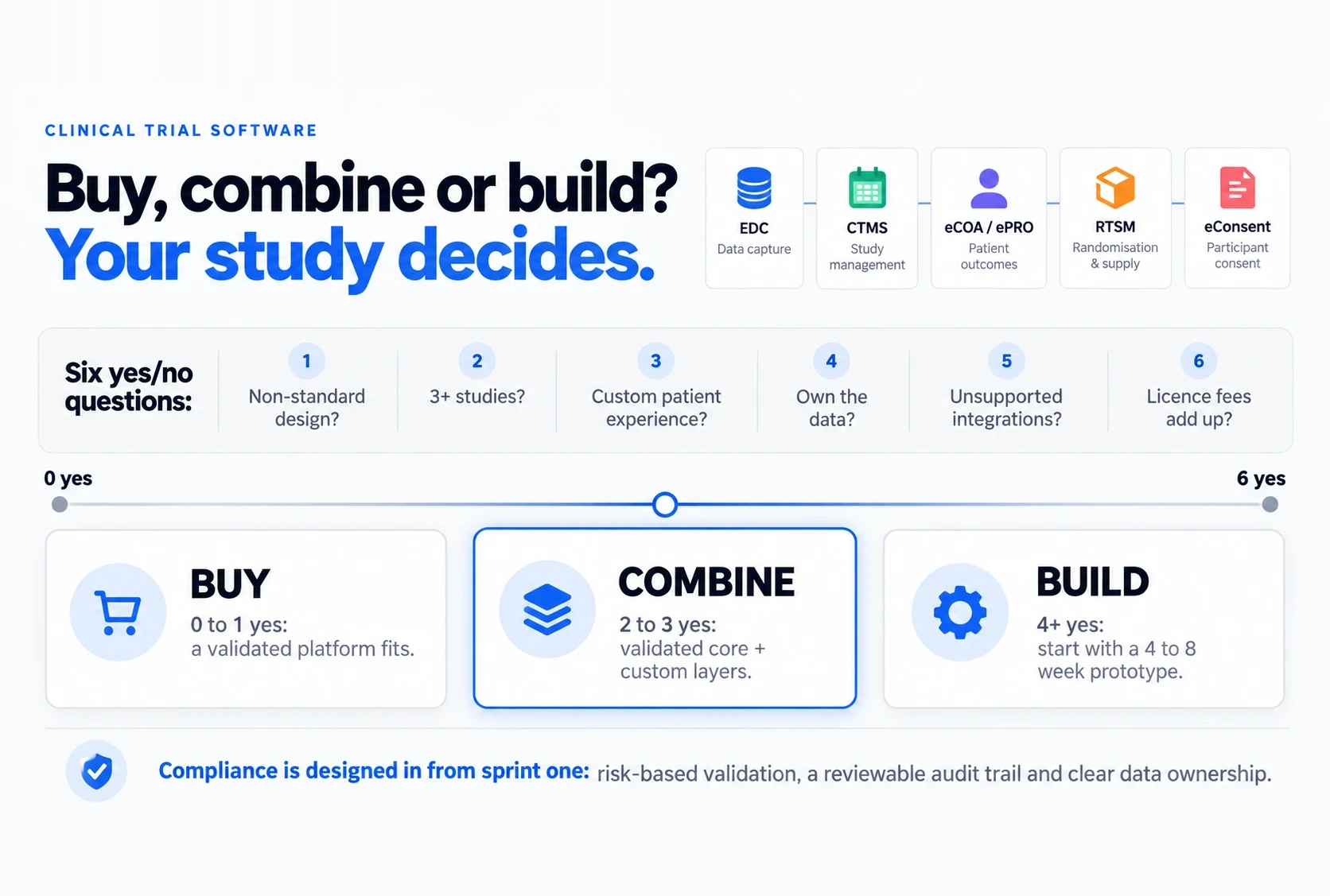
Answer these six questions about your clinical trial software development program. Each "yes" points toward building or combining.
- Does your study design depart from a standard parallel-group, site-based trial?
- Will you run three or more studies on the same data model in the next two years?
- Do participants need a purpose-built experience, such as voice, mobile or caregiver access?
- Must you own the code, IP and raw data outright?
- Do you need to connect devices, EHRs or analytics a vendor does not support?
- Would per-study licence fees exceed the cost of a one-time build within about three years?
In clinical trial software development, zero or one "yes" points to buying. Two or three points to combining. Four or more points to building, ideally starting with a prototype. This is a planning aid, not a calculation: price your own volumes before deciding.
Combine both
Many teams keep a validated platform for regulated submission data and build the parts around it: participant portals, ePRO, de-identified analytics for partners and reporting. This works when the custom layer connects through APIs. We build integrations with tools such as Medidata, OpenClinica and Veeva, and connect EHR data through HL7 and FHIR, so you are not locked into either approach. Our healthcare product development team handles both the build and the integration work in clinical trial software development.
Which Modules Does Trial Software Development Cover?
In clinical trial software development, plan for the modules your protocol needs on day one and design the data model so the rest can be added later without replatforming.
EDC and eCRF design
Study-specific eCRFs with real-time validation, skip logic, range checks and automated edit checks catch errors at the source and reduce downstream cleaning. Version-controlled forms handle protocol amendments without losing history. See our custom EDC software development service.
CTMS
A CTMS gives study teams one place to track site performance, enrollment, visit schedules and trial progress, replacing the spreadsheets sponsors and CROs often reconcile by hand. See our guide to what a CTMS is and its top features.
eCOA and ePRO
Patient-reported outcomes and clinical assessments are captured on web and mobile, with the right instruments, scheduling and reminders for each study. See our eCOA and ePRO software development service.
Randomization and trial supply (RTSM)
For randomized or blinded studies, RTSM handles treatment allocation and supply workflows. It is usually added once core data capture is in place.
eConsent and participant management
Consent versions, participant tracking and scheduling across sites, countries and languages belong in the same system as the data they govern, with country-specific consent and data-handling rules.
Decentralized and hybrid trial features
Remote enrollment, eConsent, wearable data capture and participant portals let patients take part without traveling to a site. See our decentralized clinical trial software service, and our patient registry software development service for longitudinal studies.
Reporting and data management
In clinical trial software development, dashboards, data-cleaning workflows and exports give data managers, monitors and sponsors the visibility they need, with role-based access so each user sees only what they should. For the data-management side, see our guide to clinical data management software (CDMS) features.
Which Regulations Apply to Trial Software?
Clinical data is regulated data, so clinical trial software development starts with the rules. Which rules apply depends on your countries, sponsor and submission plans, but three documents shaped expectations most between 2023 and 2025, and they agree on more than they differ.
|
Requirement |
What it means for the software |
Source |
|
FDA 21 CFR Part 11 |
Secure audit trails, access controls, electronic records and signatures |
FDA e-records Q&A, final October 2024 |
|
EU computerised-systems guideline |
Risk-based validation, audit trail review, ALCOA++ data integrity |
EMA, in force since 2023 |
|
ICH E6(R3) |
Systems fit for purpose through risk-based validation, with data governance |
ICH, adopted 6 January 2025 |
|
GDPR and HIPAA |
Safeguards for personal and protected health information |
EU and US law |
|
CDISC standards |
Data collected and exported as CDASH, SDTM, ADaM or ODM where required |
CDISC |
|
Computer system validation |
Documented requirements, risk assessment, testing and change control |
Applies everywhere |
What changed between 2023 and 2025
The EMA's guideline on computerised systems and electronic data in clinical trials defines validation as establishing and documenting that a system consistently meets its requirements, with an approach based on risk assessment. It also applies ALCOA++: data must be attributable, legible, contemporaneous, original, accurate, complete, consistent, enduring and available.
FDA finalized its guidance on electronic systems, electronic records and electronic signatures in clinical investigations in October 2024. It gives non-binding recommendations on applying Part 11 to the systems sponsors, investigators and CROs use.
ICH E6(R3) Good Clinical Practice was adopted on 6 January 2025. Its principles say computerised systems should be fit for purpose, for example through risk-based validation, and that data governance should cover ownership and responsibility across the data life cycle.
For a buyer, the common thread is risk-based validation, a reviewable audit trail and clear data ownership. Those are design decisions, so they belong in discovery, not in the final month.
Who is accountable when a vendor builds the software?
You are. The EMA guideline states that its references to sponsors and investigators also apply to their service providers, and it covers providers of eCOA, eCRF and IRT systems. Hiring a development partner does not transfer responsibility for validation, so choose one that delivers the documentation your inspectors will ask for.
CDISC data standards
CDISC defines the formats regulators expect for submission data, including CDASH for collection, SDTM for tabulation, ADaM for analysis datasets and ODM for exchange. Read the CDISC standards catalogue and confirm with your biostatistics team which ones your submission needs before the data model is fixed.
Clinical trial software development cannot produce certified-compliant software on its own. Compliance depends on how the system is built and on how your organization validates it, trains users and runs its procedures. A good clinical trial software development partner builds the technical controls in from the first sprint and delivers documentation that supports your validation and inspection readiness.
How Do You Architect and Secure Trial Software?
Good clinical trial software development is modular: one data model, separate services for capture, management and analytics, and APIs between them. That lets you add RTSM or ePRO later without replatforming, and change forms or visit schedules mid-study with version control and minimal downtime.
- EHR data: HL7 and FHIR connect the trial system to hospital and clinic records.
- Existing clinical tools: API-based or custom integrations with platforms such as Medidata, OpenClinica and Veeva.
- Devices and wearables: structured ingestion of remote monitoring and sensor data.
- Access control: role-based permissions for administrators, coordinators, participants, caregivers and external partners, with de-identified views for partners who should not see individual patient data.
Security in clinical trial software development is a feature of the data model, not an add-on. The baseline is encryption in transit and at rest built to OWASP standards, least-privilege permissions, tamper-evident audit logging of who changed what and when, de-identified exports for partners and consortia, and country-specific consent and data-handling rules for multi-country studies.
Where Does AI Help in Clinical Trial Software Development?
In clinical trial software development, AI helps most where it removes manual review and set-up work, as long as a person approves every output. Three practical uses:
- Data-quality flagging: detect outliers, inconsistencies and missing data across sites as they arrive, so data managers review exceptions instead of every record.
- AI-assisted study build: draft eCRFs and edit-check logic from a protocol document for your team to review and finalize.
- Risk-based monitoring signals: surface sites or participants that need attention, such as enrollment slowdowns or protocol-deviation patterns.
Log what the AI produced and who approved it, and keep patient data inside your privacy and regulatory boundaries. For the wider picture, read our guide to AI in healthcare product development.
How Is Clinical Trial Software Developed, Step by Step?
A realistic clinical trial software development project runs in six stages, starting with a prototype so your team sees working software within weeks.
- Discovery and protocol mapping. Map the protocol, user roles, data flows, integrations and compliance needs before design starts. Decide which modules belong in the first release.
- Prototype or MVP (4 to 8 weeks). Build a working prototype of the core data-capture workflow for one study. It is a first release for your team to test, not the full platform.
- Iterative build in sprints. Add modules, integrations and reporting in short sprints with feedback from coordinators, data managers, monitors and participants. A full build typically takes a few months, depending on scope.
- Validation and compliance testing. Run documented testing against requirements, review audit trails and access controls, and prepare the documentation that supports your validation and any inspection.
- Deployment and training. Launch to sites with training and a support path, and migrate data from existing tools where needed.
- Support and change. Protocols change. Plan for amendments, new modules and new studies, with version control and an audit trail for every change.
How Much Does Clinical Trial Software Development Cost?
Cost depends on scope more than anything in clinical trial software development. These are Latent HQ's typical ranges for clinical trial software development; your final figure depends on your protocol and integrations.
|
Build |
Typical cost and timeline |
What it covers |
|
Prototype or MVP |
From $15,000, 4 to 8 weeks |
Core data-capture workflow for one study, built to show value quickly |
|
Full custom platform |
$70K to $175K, a few months |
EDC or CTMS core with the modules, integrations and validation your study needs |
|
Enterprise multi-study platform |
$175K to $250K+, several months or more |
Multi-study, multi-country platform with deeper integrations, CDISC standards and full validation documentation |
What moves the number:
- The number of studies, sites and countries.
- Which modules you need: EDC, CTMS, ePRO, RTSM, eConsent, reporting.
- Integrations with existing systems, EHRs and devices.
- Depth of validation and documentation.
- Data migration from current tools.
- AI features and analytics.
- Ongoing hosting, support and enhancements after launch.
For adjacent budgeting, see our healthcare app development cost guide. We offer hourly or scope-based pricing, and you own the code, IP and data. Share your protocol and integration needs and we will scope the build and price against it.
Case Study: A Decentralized Research Platform for ALS
A patient-focused nonprofit in the ALS research space needed to run many studies remotely, collecting speech, respiratory, motor and cognitive data from patients who often could no longer travel to a clinic. Its technology was spread across disconnected tools, and research data was effectively trapped.
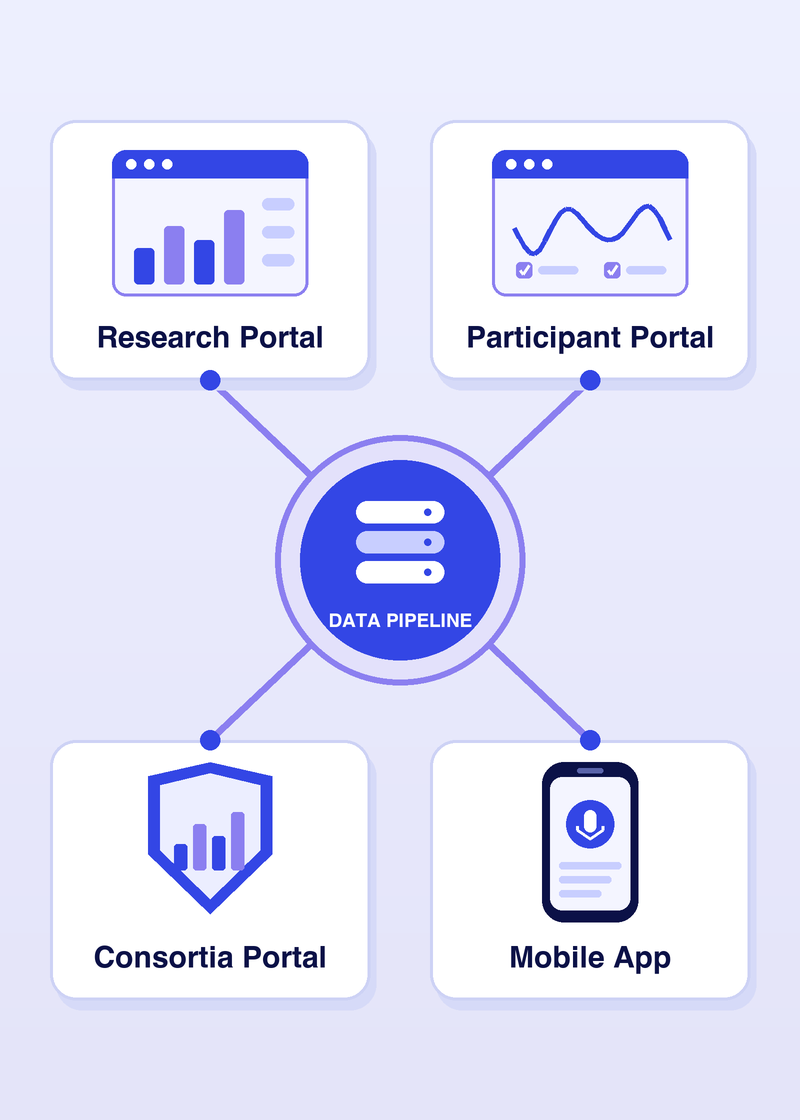
We rebuilt it as one research ecosystem of four connected systems on a single data pipeline: a research portal for coordinators, a participant portal with standardized clinical assessments and consent management, a de-identified consortia portal giving pharma and academic partners aggregated visibility, and a mobile app for patients. The platform now runs eight studies, including a live clinical trial. Read the full ALS research platform case study.
What Mistakes Should You Avoid When Building?
- Treating validation as the last step of clinical trial software development. Plan documentation and testing from discovery. Late validation creates rework and delays go-live.
- Building every module at once in clinical trial software development. Start with the core workflow, prove it, then add RTSM, ePRO and reporting.
- Ignoring protocol amendments. Design form and logic versioning from day one so mid-study changes keep a clean history.
- Underestimating usability. Coordinators and participants abandon clumsy tools. Test with real users, including patients with limited mobility or dexterity.
- Leaving integrations until late. Define the interfaces to EHRs, EDC and devices early, because they shape the data model.
- Skipping migration planning. Decide how existing data moves, and how it is verified, before launch.
- Ignoring ownership and exit. Make sure you own the code, IP and data and can move them if your needs change.
How Do You Choose a Clinical Trial Software Development Partner?
For clinical trial software development, choose the partner who can show delivered research platforms, explain how they support your validation and let you own the result. Check these eight points:
- Clinical domain experience: ask to see research platforms they have delivered, not only generic apps.
- Compliance approach: how they handle audit trails, access control, validation documentation and inspection readiness.
- Data standards: whether they support CDISC and the exports your submissions need.
- Integration track record: experience with EDC, CTMS, EHR (HL7 and FHIR) and device data.
- Ownership: clear ownership of the code, IP and data, with no lock-in.
- Delivery model: sprints, named project managers and milestone reporting.
- Pricing transparency: published ranges and a clear way to scope your build.
- Support after launch: a plan for amendments, new modules and new studies.
See how we work on our clinical research software development page.
Conclusion
The best clinical trial software development fits the protocol, protects the data and can change when the study does. Decide early whether to buy, build or combine, design compliance and standards in from the first sprint, start with a prototype that proves value, and choose a clinical trial software development partner who shows you delivered research platforms and lets you own the result.
If you are scoping a platform, book a free scoping call and bring your protocol.
FAQs
1. What is clinical trial software development?
Clinical trial software development is the design and build of the systems used to run clinical studies: EDC, CTMS, eCOA and ePRO, RTSM, eConsent, decentralized trial portals and the integrations and reporting around them. Teams commission it when off-the-shelf platforms do not fit their protocol, study model or data-ownership needs.
2. How long does clinical trial software development take?
A focused prototype of the core data-capture workflow for one study typically takes 4 to 8 weeks, and clinical trial software development for a full custom platform takes a few months. Modules, integrations and validation scope set the final timeline.
3. How much does custom clinical trial software development cost?
Latent HQ's typical ranges are from $15,000 for a prototype, $70K to $175K for a full custom platform and $175K to $250K+ for enterprise multi-study platforms. The number of studies and sites, modules, integrations and validation depth set the final figure.
4. Can custom clinical trial software be 21 CFR Part 11 compliant?
Software cannot be certified Part 11 compliant by itself, because compliance also depends on your validation, procedures and training. It can be built with the technical controls Part 11 expects: secure audit trails, access controls and electronic-signature support, plus documentation that supports your validation and inspections.
5. Should we build or buy an EDC system?
Buy when your study is standard and a validated platform fits. Build, or build around a validated core, when you have an unusual study design, need to own the data model and IP, need a specific patient experience or want to avoid per-study licence costs across a portfolio. Many teams combine both through APIs.
6. Which CDISC standards should clinical trial software support?
That depends on your study and submission plans. Commonly relevant standards include CDASH for data collection, SDTM for tabulation, ADaM for analysis datasets and ODM for data exchange. Confirm the list with your biostatistics team before the data model is fixed.
Related Insights
- Electronic Data Capture (EDC) in Clinical Trials — how EDC works, its core components and what it does for data quality and compliance.
- AI in Healthcare Product Development in 2026 — where AI adds value in regulated healthcare products and where it needs guardrails.
- Healthcare App Development Cost Guide — how scope, compliance and integrations drive the cost of healthcare software.
- What Is a Clinical Trial Management System (CTMS) — the operational layer that tracks sites, enrollment and monitoring.
- Clinical Data Management Software (CDMS) Features — what a modern CDMS must include for clean, submission-ready data.