
Patient registry software development means building the system that enrolls people and collects their data over years. It also shares that data safely with research partners. Foundations, hospitals and sponsors commission it when spreadsheets and trial tools stop working. This guide covers registry types, build versus buy, features, standards, consent, process and cost.
Key Takeaways
- Patient registry software development starts with the registry type. A disease, product, health-services or rare disease registry each needs a different data model, consent flow and follow-up plan. Choose the type before you choose a patient registry platform.
- Build when the registry must outlive one study, own its data model or serve several partners. Buy when validated clinical registry software already fits your disease, your workflow and your budget without heavy changes.
- Consent, audit trails and role-based access are design inputs, not final checks. Versioned consent, de-identified partner views and standards such as FHIR and CDASH keep patient registry software development defensible years after launch.
- Latent HQ lists registry MVPs at 6 to 10 weeks and has not published a registry price tier. Its oncology registry for Tata Memorial was built within a $50,000 to $75,000 budget band.
What Is Patient Registry Software Development?
Patient registry software development is the work of building a system for one clear purpose. It collects the same data from every patient, over time. The purpose might be tracking a disease, following a device or measuring care quality. The software must keep that data consistent for years.
An electronic health record (EHR) serves the care of one patient. A patient registry system uses the same fields for many patients. That lets groups be compared. An electronic data capture (EDC) system serves one study with a fixed end date. It often has no end date. It may feed several studies.
Latent HQ's registry service page draws the same line. An EDC system covers one study. A registry tracks a group for years. That difference drives every build choice. It needs sign-up, screening, consent records and repeat visits. Its reports must stay stable as new questions arrive. Teams that treat a registry as a bigger form soon hit limits. Patient registry software development expects change, so it plans for it.
Most buyers fall into four groups:
- Rare-disease foundations that need one trusted dataset.
- Hospitals and specialty units that track outcomes for a procedure.
- Device and drug sponsors that follow patients after approval.
- Research institutions that want a pool of people for future trials.
You can spot the need early. Data sits in several spreadsheets. Staff retype the same values. Partners ask for reports you cannot produce. At that point many teams bring in a healthcare software development company to scope the build. A good patient registry software development brief names the purpose, the population and the partners first.
A patient registry differs from an EDC system in time span. An EDC system captures one study. A registry tracks one group for years and often supplies several studies.
Patient Registry Software Development: Which Type?
Patient registry software development begins with the registry type. Each type changes the data model and the follow-up plan. Four types cover most projects. Name yours early to avoid a redesign after the first hundred enrollments.
|
Registry type |
What it tracks |
What it changes in the build |
|
Disease |
Patients who share a diagnosis |
Long follow-up, symptom scales, repeat visits |
|
Product |
Patients who use a drug or device |
Safety events, exposure dates, reporting duties |
|
Health services |
Care delivery and outcomes |
Site-level data, quality measures, fair comparison rules |
|
Rare disease |
Small groups spread across regions |
Remote entry, natural history data, trial matching |
Latent HQ's registry page lists rare-disease and oncology builds. A disease registry is the common start. You enroll people with one condition and follow them through visits. The forms will change as clinical knowledge grows. The software must handle that. A product registry follows people who use a drug or device. Safety events and exposure dates matter most. Reporting duties can shape the screens.
A health-services registry compares sites or providers. It needs clean site data and clear rules for fair comparison. A rare disease registry has the opposite problem. Patients are few and far apart. Many cannot travel. Remote entry and strong data checks matter more than volume.
Many programs mix types. A foundation may run a disease registry and a product registry together. Design the data model so one person can sit in both without duplicate records. Write your registry type in one sentence before design starts. Patient registry software development moves faster when all share it.
They also sit inside larger research programs. Share one data model across both. That saves rework. Our guide to clinical trial software development shows how registries and trial systems share data models. Good patient registry software development plans for that link from the start.
In patient registry software development, choose the registry type first. It sets the follow-up schedule, the consent wording and the fields you must test before enrollment opens.
Build or Buy a Patient Registry Platform?
Patient registry software development is worth the cost in one case. No patient registry platform on the market fits your disease, your partners and your data ownership needs. Buying is faster for standard cases. Building pays off when the data is the long-term asset.
Use this table to test your own case.
|
Question |
Buy a platform when |
Build when |
|
Scope |
One condition, standard forms |
Several diseases or studies over time |
|
Data model |
Vendor fields match yours |
You must own and extend the model |
|
Partners |
Few, with simple access |
Pharma, academic and hospital partners need separate views |
|
Lifespan |
A defined program with an end |
A registry meant to run for many years |
|
Licence cost |
Fees stay small as you grow |
Per-seat or per-study fees multiply |
Count how many rows point to building. Four or five is a strong signal. One or two means a configurable product may serve you well. Test it with a real enrollment flow before you sign. A hybrid is often the practical answer. You can buy a validated core and build the parts that differ. Examples are de-identified partner dashboards or a custom consent flow. Plan the integration points before you sign a licence.
Price is one part of the choice. Ask what happens to your data if you leave. Ask how a new form is added and who pays for it. Ask how partner access is set up. Patient registry software development answers those questions in your favor when you own the model. A bought product answers them in the vendor's contract.
Some EHR vendors also sell registry modules. For a small registry inside one hospital, that may be enough. When it must pull data from several systems, a dedicated build is easier to control. Our EMR and EHR software development work covers those connections.
Ownership deserves its own question. If a vendor holds the data model, moving later is slow and costly. Latent HQ's registry service page states that the client owns the code, the data and the documentation. That keeps your options open. Patient registry software development should never lock your research data inside one vendor.
Build a patient registry platform when the registry must outlast one study. Buy when a validated product fits today's protocol and its licence cost stays flat as you grow.
Which Clinical Registry Software Features Matter?
Patient registry software development should deliver six features first. Good clinical registry software signs up the right people. It captures clean data over time and protects names. Extras can wait for later releases. Rank every feature by its effect on data quality.
|
Feature |
What it does |
Why it matters |
|
Sign-up and screening |
Web and mobile sign-up with screening rules |
Keeps the group clean from day one |
|
Consent capture |
Saves which consent version each person accepted |
Proves permission for each record |
|
Repeat forms |
Repeat visits with skip logic and field checks |
Cuts cleaning work later |
|
Role-based access |
Separate views for staff, doctors and partners |
Limits who sees personal data |
|
Partner dashboards |
Group views with no names |
Gives partners value and protects patients |
|
EHR and EDC links |
EHR, EDC and wearable data through standard links |
Avoids double entry |
Latent HQ's registry service page lists the same core. It names sign-up, consent capture, checked forms, partner dashboards and EHR and EDC links. Capturing data over time is the hard part. The same person returns many times. Forms change as the protocol changes. Version every form and keep old answers readable. Edit checks and skip logic catch errors at entry. Fixing a mistyped value on the day is cheap. Fixing it two years later, after analysis has started, is not. Coordinators also need admin tools to flag and fix data issues over time.
Links to other systems decide how much staff time you save. If it reads from the EHR, coordinators stop retyping lab values. It also lowers the chance of typing errors.
Patient-facing features matter too. Mobile entry, plain words and easy design raise completion rates. This is true most of all for patients with limited mobility. Scale matters as well. Latent HQ says its registry design can grow from a few hundred to tens of thousands of people. It needs no rebuild. Ask any team you hire how it handles growth.
Keep the first release small. Patient registry software development goes wrong when teams add every dashboard on day one. Enrollment then waits.
Clinical registry software earns its keep through clean data. Favor edit checks, versioned forms and role-based access over dashboards at first.
Patient Registry Software Development: Which Standards?
Patient registry software development must name its data standards early. Standards decide how easily the data moves later. Three matter most for US-led programs. FHIR covers exchange. CDASH covers collection. Audit rules cover the system itself.
FHIR is a standard for exchanging healthcare information electronically. It is built on small units called resources. The HL7 FHIR overview explains this. A system that speaks FHIR can read from EHRs and pass data on. It needs no custom code for every partner. For a wider look at older links, see our comparison of HL7 vs FHIR.
According to CDISC, CDASH sets a standard way to collect data the same way across studies and sponsors. It gives clear traceability into the Study Data Tabulation Model (SDTM). If your data may feed trials, CDASH-style field definitions save mapping work later.
Audit trails and access control are system needs. Under 21 CFR 11.10, controls for closed systems include limiting access to authorized individuals. They also include secure, computer-generated, time-stamped audit trails. See the electronic code text. Whether Part 11 applies depends on how you use the data. Confirm that with your quality team.
Privacy follows the same pattern. Protected health information needs role-based access and field-level controls. Keep identifiable and de-identified views apart. Ask where the data lives. Ask who can reach it. If people live in the EU or India, local privacy and ethics rules apply on top. Ask your counsel to confirm them before you fix the data model.
Latent HQ describes its registry work as HIPAA and GDPR-ready. Its data handling is aligned to 21 CFR Part 11, with built-in audit trails. That is a design approach for patient registry software development. Compliance decisions and submissions stay with your own quality and legal teams.
Patient registry software development stays defensible when standards, audit trails and access control are built in early. Adding them after launch is far harder.
Who Owns Consent and Governance?
Patient registry software development has to support consent and governance. Decide who owns both before the first person enrolls. Consent is the permission to collect and use data. Governance is the set of rules for who may see and use it.
Digital consent needs versioning. Tie each person to the exact consent text they accepted. When the protocol changes, the software must ask for re-consent. It must record the new answer without erasing the old one. Latent HQ's registry page describes digital consent with versioning. You can see which version each person agreed to. People also need a way to withdraw. Decide in advance what happens to data already collected. Build that rule into the software. Do not handle it by email.
Governance usually means a small committee. It reviews requests for data, approves partner access and checks that each use matches consent. The software should give that group a clear audit trail of every request and every approval. A patient registry software development plan without this step leaves partners guessing.
Partners rarely need names. A de-identified dashboard shows group progress to hospitals, sponsors and academic teams. They see no single records. Keep it apart from the data your own team uses. A registry can also become a recruiting pool for later studies. If that is a goal, ask for consent to be contacted at enrollment. Our work on clinical research software development covers how a registry-to-trial path connects to EDC systems.
Ethics review matters here too. An institutional review board (IRB) or ethics committee usually approves the consent text and the data plan. Share the data dictionary and consent flow with that group early. Late changes to screens can mean a new review. Put the review time into your patient registry software development schedule. Early review saves weeks.
Treat consent as data. Store the version each person accepted. Ask for re-consent when the protocol changes. Give a governance group a full audit trail of every data request.
How Does Patient Registry Software Development Work?
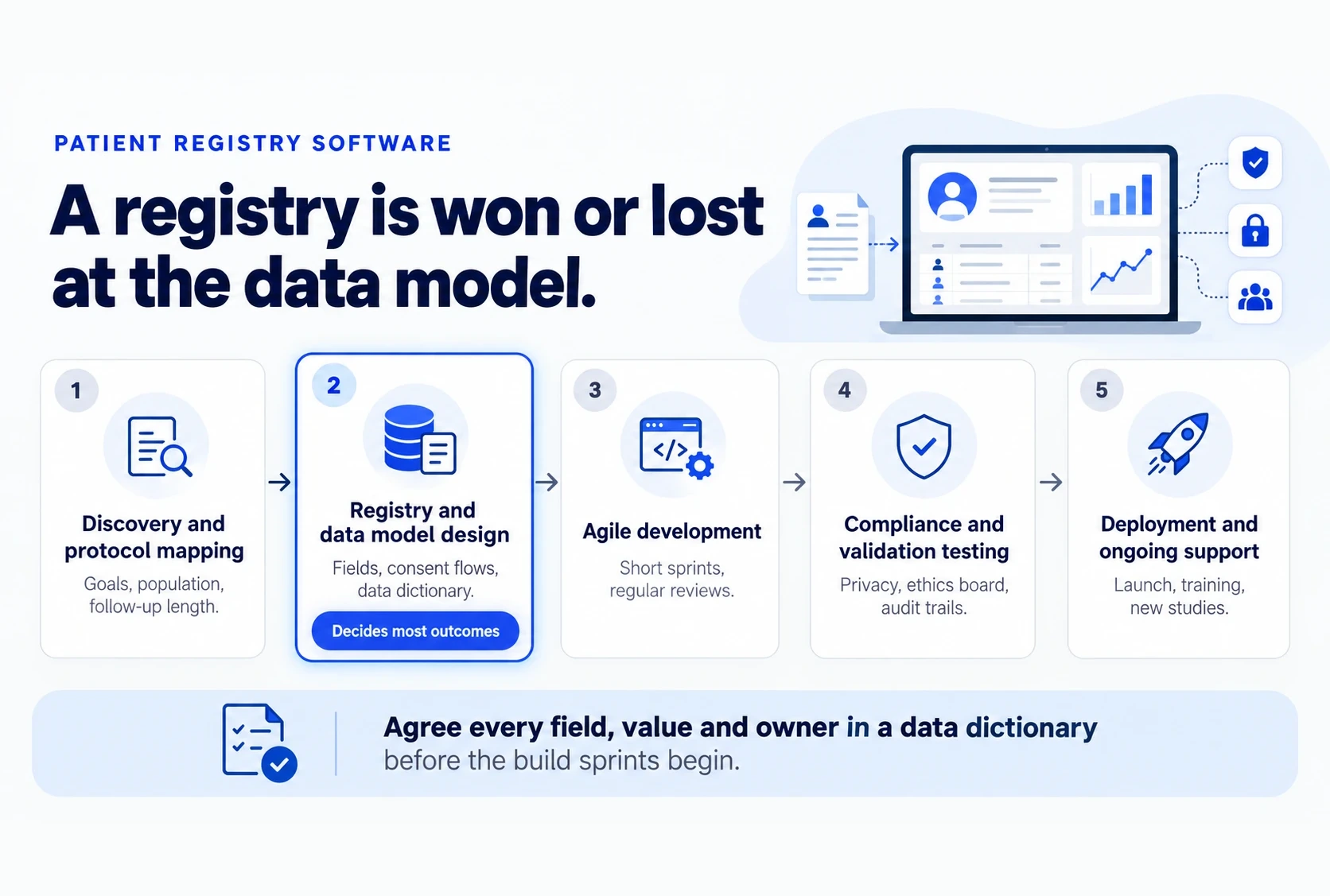
Patient registry software development follows five stages, from protocol mapping to long-term support. Latent HQ lists a working registry MVP at 6 to 10 weeks on its service page. It then grows with the research program. Timelines vary with scope.
- Discovery and protocol mapping: agree the research goals, the population and how long you need to follow people.
- Registry and data model design: define fields, consent flows and the patient path for your disease or purpose.
- Agile development: build in short sprints with regular reviews, so it changes as your questions change.
- Compliance and validation testing: test privacy controls, ethics-board needs and audit trails before launch.
- Deployment and ongoing support: launch, train your team and add studies and partners over time.
Stage two decides most outcomes. A data dictionary lists every field, its allowed values and its owner. It prevents arguments later. Spend real time there. It pays back fast. Patient registry software development stays cheap only while the data model stays stable.
Stage four is more than bug testing. You confirm that access rules work. You confirm that audit entries are complete. You confirm that consent versions are stored correctly. Ask for written results you can keep. A strong example is the platform Latent HQ built for a patient-focused ALS nonprofit. It runs as an ALS research platform with separate portals for staff, patients and partner consortia. The design shows why role-based access and de-identified views belong in the first plan.
Teams often repeat the same mistakes. They skip the data dictionary. They add forms for every partner request. They treat consent as a checkbox. They leave support out of the budget. Each mistake is cheap to avoid in discovery. Each is costly to fix after launch. Fix them early. A short review of these four items belongs in every patient registry software development plan. Write them on one page and review it each quarter.
Stage five never really ends. New studies, new partners and new consent versions arrive for years. Budget for that support from the start.
Use the discovery stage to test your partner too. Ask to see a past data dictionary, a consent flow and an audit log from a real build. Ask who stays on the team after launch. Ask how the team handles a protocol change in month eight. Clear answers show whether a team has run patient registry software development before or only read about it.
Patient registry software development succeeds or fails at the data model stage. Agree every field, value and owner in a data dictionary before the build sprints begin.
What Does Patient Registry Software Development Cost?
Patient registry software development cost depends on scope, not on the word "registry". Two registries can differ ten times in price. One may hold a few simple forms for one clinic. Another may serve many sites, many consent versions and several partners.
Ask each vendor to price the same scope. Then you can compare quotes fairly. Latent HQ has not published a registry price tier. It does publish one real registry budget band and nearby ranges. They give honest reference points. They are not a quote for your project.
The best reference is Formly, built for Tata Memorial Cancer Hospital. The Formly oncology disease registry case study lists a $50,000 to $75,000 budget. It covers several registries on one web platform, plus mobile entry and auto-fill.
|
Reference |
Published figure |
What it tells you |
|
Formly oncology registry |
$50,000 to $75,000 budget |
A multi-registry web platform with mobile entry |
|
Registry MVP timeline |
6 to 10 weeks |
How fast a first registry can launch |
|
Clinical research prototype |
From $15,000 |
A single-study data capture core |
|
Full custom EDC or CTMS platform |
Typically $70K to $175K |
Study systems with modules and validation |
The last two rows come from Latent HQ's clinical research service page. They are neighbors, not registry quotes. Treat them as published ranges, not a quote. Five factors move the price up or down:
- The number of registries or forms on the platform.
- How many repeat visits and form versions you must track.
- Consent depth, including re-consent and withdrawal.
- Partner dashboards and de-identified analytics.
- Integrations with EHR or EDC systems, and how much validation you need.
Ongoing cost matters as much as build cost. Hosting, support and new studies continue for years. Ask for a maintenance estimate with every patient registry software development quote. Hidden costs also appear. Moving old spreadsheet data into a new model takes time. Training coordinators takes time. Ethics reviews add calendar days even when they add no code.
A fair way to scope is to build a small first version for one disease, then extend it. That keeps the first budget small and shows what the second release needs.
Registry cost follows scope. Ask for a scoped estimate built from your forms, visits, consent rules and integrations. Do not rely on one market-wide number.
What Do the ALS and Formly Registries Show?
Patient registry software development looks different in practice. Latent HQ's two registry builds show three patterns. The case study pages state the details. Client details stay as those pages give them. The first pattern is scale through structure. The ALS platform now supports more than 900 people across eight active studies, according to Latent HQ's case study. It uses staff, participant and consortia portals, plus a mobile app. Structure let one dataset serve many studies.
The second pattern is separation. The ALS platform keeps personal data apart from partner views. It uses role-based access and a setting that hides or shows protected data. Formly shows a different strength. It holds several disease registries on one platform for oncologists who had used scattered spreadsheets.
The third pattern is fit to the user. People with ALS often cannot travel or type easily, so the platform was built for limited mobility. Formly's oncologists needed mobile-friendly entry during rounds and auto-fill to speed up repeat data. The builds used ordinary technology. What mattered was a clear registry type, a stable data model and attention to who enters the data. That is what patient registry software development looks like in practice.
The two builds point the same way in patient registry software development. A registry earns trust when its structure, access rules and entry screens match the people who use them.
Conclusion
Patient registry software development pays off when you pick the registry type first. Decide build or buy with a real scorecard. Treat consent and audit trails as design inputs. Start small with one disease, prove the data model and then extend. Good patient registry software development keeps the scope tight and the data model stable.
Scoping a patient registry system now? Talk to a team that has built one. Our custom patient registry platform service starts with a discovery conversation. You can book a free scoping call to walk through your protocol, partners and consent model.
FAQs
1. What is patient registry software?
Patient registry software, also called a patient registry system, enrolls people. It collects the same data from each person over time. A good patient registry platform also records consent. It controls who sees personal data. It shares de-identified views with partners.
2. How is a patient registry different from an EDC system?
An EDC system captures data for one study with a set end. A registry tracks a population for years and often feeds several studies. Many programs connect the two, so people in the registry can join future trials.
3. How much does patient registry software development cost?
Patient registry software development cost depends on scope. Latent HQ has not published a registry price tier. Its Formly oncology registry was built within a $50,000 to $75,000 budget. Forms, visits, consent rules, dashboards and integrations move the figure.
4. How long does patient registry software development take?
A patient registry software development project can reach a working MVP in 6 to 10 weeks, according to Latent HQ. Larger registries with many forms, partners or integrations take longer. Most grow in releases as new studies are added.
5. Can clinical registry software connect to an EHR?
Yes. Clinical registry software can read from and write to an EHR through standard interfaces such as HL7 and FHIR. That saves staff from retyping data. How deep that link goes is a big cost driver, so scope it early.
6. How do you share registry data without exposing patient identities?
Build separate de-identified dashboards for partners. Keep personal data in a restricted area. Role-based access and audit trails then show who viewed what. A governance group can approve each request.
Related Insights
- What Is Electronic Data Capture (EDC) in Clinical Trials and How Does It Work — Understand how electronic data capture in clinical trials works, its benefits, core components, and how EDC systems improve data quality...
- What Is a Clinical Data Management Software (CDMS) and Key Features Every Clinical Data Management Software Must Have — Learn what clinical data management software (CDMS) is, how it supports high-quality clinical data collection, and the essential features...
- What Is a Clinical Trial Management System (CTMS) and Top Features of a Modern CTMS — Learn what a clinical trial management system is, how CTMS platforms streamline study operations, and the essential features modern...
- HIPAA Compliant App Development: Technical Requirements and Developer Checklist (2026) — Build HIPAA-compliant healthcare apps in 2026 with updated technical requirements, security measures, and a practical developer checklist...
- FHIR Integration for Healthcare Apps: Common Data Flows, Testing Steps, and Pitfalls to Avoid — Explore how we're leveraging FHIR to deliver reliable healthcare app connectivity, covering dominant data flows, practical testing...